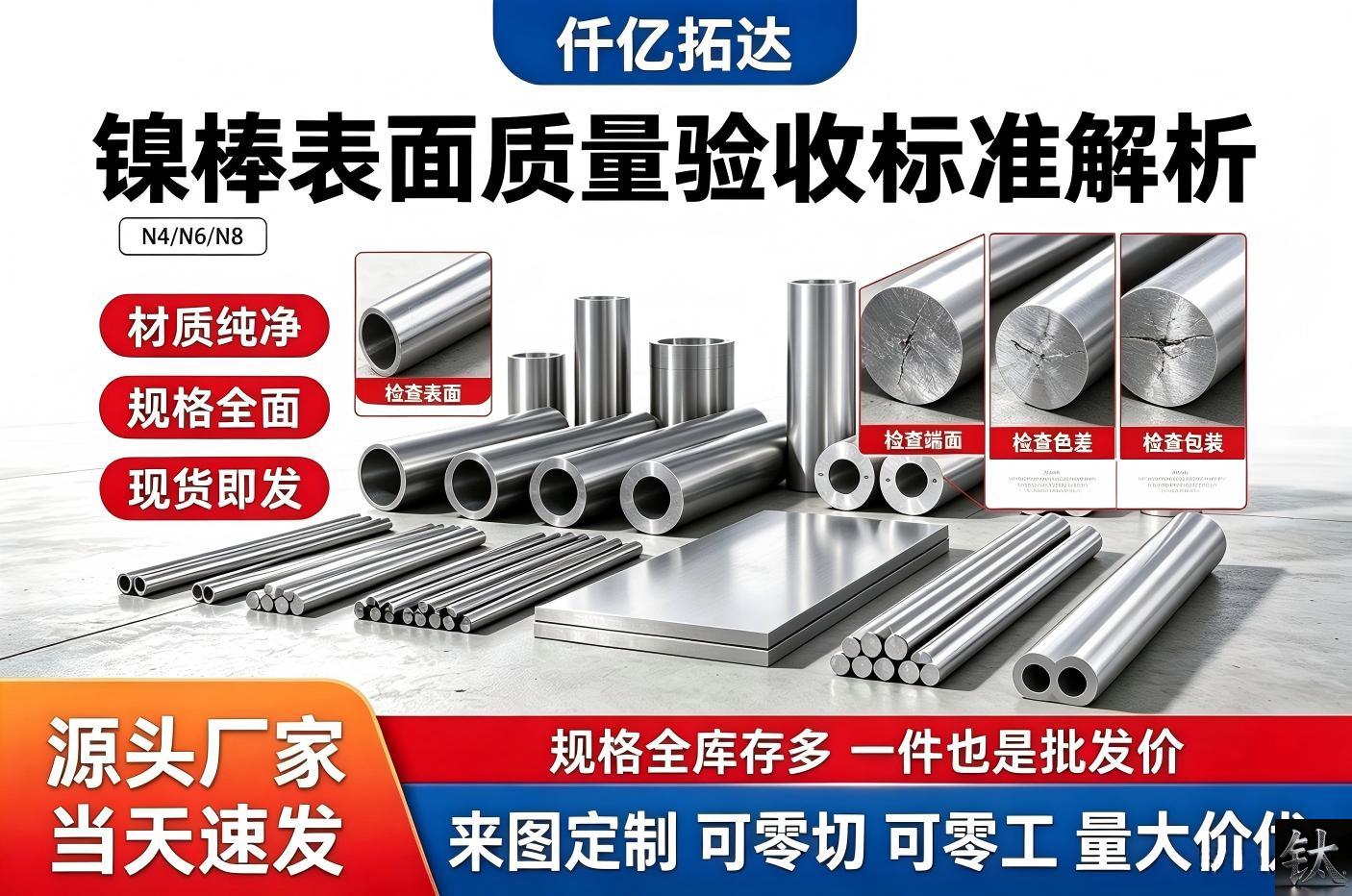
Ni200 vs Ni201 Nickel: Caustic Service Grade Selection
| Specification | ASTM B162 plate, B161 pipe, B160 bar, B163 condenser tube |
|---|---|
| Applicable Standard | Nickel 200 (UNS N02200, N6) vs Nickel 201 (UNS N02201, N4) |
| Material Condition | Caustic soda (NaOH), chlor-alkali evaporators, alkaline processing |
| Inspection & Packaging | Nickel 200 below 315C; Nickel 201 above 315C — graphitization boundary |
| Reference Price | $100.00 |
Product Description: Nickel 200 (N6) for caustic soda below 315C, Nickel 201 (N4, UNS N02201) for service above 315C. ASTM B162 caustic alkali grade selection guide for chlor-alkali evaporators.
Product Overview
| Item | Detail |
| Standards | ASTM B162 (plate/sheet), B161 (seamless pipe), B160 (bar/wire), B163 (condenser tube), B725 (welded pipe) |
| Grades | Nickel 200 (UNS N02200, N6) vs Nickel 201 (UNS N02201, N4) |
| Service | Caustic soda (NaOH), chlor-alkali evaporators, alkaline processing |
| Core distinction | Carbon content: Ni200 (0.15% max) vs Ni201 (0.02% max). The 315C graphitization boundary separates them. |
1. The Failure That Defines the Question
In 2018, a Chinese chlor-alkali plant reported sudden tube rupture in a nickel caustic evaporator operating at 350 degrees C. The material was ASTM B162 Nickel 200 (N6), installed per the original specification. The failure mode: intergranular graphitization — carbon dissolved in the nickel matrix at elevated temperature precipitated as graphite at the grain boundaries. The grain boundary graphite reduced ductility to near zero; thermal shock from a process upset cracked the embrittled tube wall.
The plant metallurgist identified the root cause: Nickel 200 is limited to 315 degrees C (600 degrees F) continuous service by the ASME Boiler and Pressure Vessel Code. Above this temperature, carbon precipitation accelerates and the material embrittles. The specification should have called for Nickel 201 (UNS N02201) — the low-carbon variant (C max 0.02%) — for all components above 315 degrees C. The fix: replace the entire evaporator tube bundle with Nickel 201.
This case defines the central question: the difference between Nickel 200 and Nickel 201 is not a quality grade — it is a temperature boundary. Below 315 degrees C, they are interchangeable. Above 315 degrees C, only Nickel 201 is safe.
2. The Two Grades at a Glance
| Property | Nickel 200 (N6) | Nickel 201 (N4) |
| UNS | N02200 | N02201 |
| Chinese grade | N6 (GB/T 5235) | N4 (GB/T 5235) |
| Carbon (max) | 0.15% | 0.02% |
| Ni (min) | 99.0% | 99.0% |
| UTS (min, plate) | 380 MPa | 345 MPa |
| Yield (min) | 100 MPa | 80 MPa |
| Elongation (min) | 35% | 40% |
| Max service temp | 315C (600F) | 1200C+ |
| Density | 8.89 g/cm3 | 8.89 g/cm3 |
The only compositional difference is carbon: Nickel 200 allows up to 0.15% C; Nickel 201 limits carbon to 0.02% C. Nickel 201 has 7.5x less carbon than Nickel 200 maximum. This single difference controls the temperature boundary.
3. Why Carbon Matters Above 315 Degrees C
Carbon is soluble in the nickel matrix at room temperature. At elevated temperatures, solubility decreases — carbon comes out of solution and precipitates as graphite at grain boundaries. The process is called graphitization.
The mechanism operates in three temperature ranges:
- Below 315 degrees C: Carbon remains in solution or precipitates very slowly. Mechanical properties are stable. Nickel 200 and Nickel 201 are metallurgically equivalent.
- 315 to 425 degrees C: Graphitization begins in Nickel 200. Carbon precipitates as discrete graphite particles at grain boundaries. Ductility decreases gradually. Nickel 201, with 7.5x less carbon, remains unaffected.
- Above 425 degrees C: Graphitization accelerates rapidly in Nickel 200. Grain boundary graphite forms continuous films. Ductility drops sharply. Impact toughness approaches zero. Nickel 201 still resists graphitization due to its low carbon content.
The kinetics are carbon-content-dependent: Nickel 200 (0.15% C max) graphitizes while Nickel 201 (0.02% C max) does not, at the same temperature and exposure time. The ASME Boiler and Pressure Vessel Code recognizes this by limiting Nickel 200 (UNS N02200) to 315 degrees C for pressure-retaining service. Above this temperature, Nickel 201 (UNS N02201) is the code-compliant choice.
4. Where Nickel 200 (N6) Is the Correct Choice
Nickel 200 is the correct grade for:
- Caustic soda (NaOH) service below 315 degrees C — the majority of chlor-alkali evaporator stages operate at 100–250 degrees C
- Caustic potash (KOH) service below 315 degrees C
- Food processing equipment — nickel is FDA-approved for food contact
- Chemical processing at moderate temperatures — alkaline salt solutions, dry halogens
- Plating and electronics applications — where temperature is not a factor
- Any service where temperature does not exceed 315 degrees C
In these conditions, Nickel 200 and Nickel 201 are metallurgically interchangeable. Nickel 200 is slightly stronger (higher carbon provides solid-solution strengthening) and marginally cheaper (more common, larger supply base). For service below 315 degrees C, Nickel 200 is the economical choice.
5. Where Nickel 200 (N6) Fails
Nickel 200 is at risk in:
- Any continuous service above 315 degrees C — ASME Code limit
- Caustic evaporator final-effect tubes — typically operating at 350–450 degrees C
- High-temperature alkaline processing above 315 degrees C
- Molten salt service
- Any application where thermal cycling pushes above 315 degrees C intermittently
Key point: The failure is insidious. The tube may operate normally for months or years while graphitization progresses silently. The first sign is often catastrophic — a crack from thermal shock that a ductile material would have absorbed. Non-destructive detection of graphitization is difficult; metallographic examination of a sample cross-section is the most reliable method. If the service temperature has exceeded 315 degrees C for an extended period, assume graphitization has begun.
6. Where Nickel 201 (N4) Earns Its Position
Nickel 201 is the correct grade for:
- All service above 315 degrees C — the temperature boundary defined by ASME
- Caustic evaporator high-temperature effects (350–450 degrees C)
- Furnace components in reducing atmospheres up to 1200 degrees C
- Any application where intermittent temperature excursions above 425 degrees C are possible
The low carbon content (0.02% max) prevents graphitization at all practical service temperatures. Nickel 201 retains ductility and impact toughness up to 1200 degrees C and beyond. The slight strength penalty (lower carbon means less solid-solution strengthening, 345 vs 380 MPa UTS) is acceptable: in high-temperature service, creep resistance and ductility matter more than yield strength.
Nickel 201 does not "make the system better" — it makes the system safe at the temperatures where Nickel 200 is prohibited. Below 315 degrees C, specifying Nickel 201 offers no advantage over Nickel 200.
7. Temperature and Concentration Service Map
| Service temp | NaOH concentration | Grade | Reason |
| Below 315C | Any | Ni200 (N6) | Carbon stable, economical |
| 315–425C | Below 50% NaOH | Ni201 (N4) | Graphitization risk on Ni200 |
| 315–425C | Above 50% NaOH (conc.) | Ni201 (N4) | Graphitization + stress corrosion |
| Above 425C | Any | Ni201 (N4) | Ni200 embrittled, ASME prohibited |
| Above 600C | Any | Ni201 or higher alloy | Consider Ni-Cr-Fe alloys (Inconel 600) |
Note: The 315 degrees C boundary is defined by ASME B&PVC for pressure-retaining service. For non-pressure applications (e.g., heating elements), the boundary may be less critical, but graphitization still occurs and reduces component life.
8. Cost Economics
The price difference between Nickel 200 and Nickel 201 is small — typically 2–5% premium for Ni201. Both are commercially pure nickel; the premium does not come from raw material cost but from the tighter quality control required to achieve the low-carbon specification in the melt.
Compare this to the cost of a graphitization failure:
- Unscheduled shutdown of a caustic evaporator: $50,000–$200,000 per day in lost production
- Tube bundle replacement: $50,000–$500,000 depending on size and nickel price
- If the failure causes caustic leak: environmental cleanup, safety incident, regulatory report
The 2–5% premium for Ni201 in the high-temperature zone is trivial relative to the risk. Specifying Ni200 above 315 degrees C to save 2–5% on material is a false economy — the material cost saving is measured in thousands of dollars, while the failure cost is measured in hundreds of thousands.
Conversely, specifying Ni201 for the entire system — including the 80–90% of components that operate below 315 degrees C — pays for a low-carbon specification that is not needed. The temperature boundary approach (Ni200 below, Ni201 above) is the correct economic and engineering answer.
9. Engineering the Temperature Boundary
The temperature boundary is an engineering specification, not a material property gradient:
- Multi-effect evaporator: In a caustic soda evaporator, the first effect (highest temperature, ~350–400 degrees C) uses Ni201; later effects (~100–250 degrees C) use Ni200. The boundary is between effects, not within a single tube.
- Piping transitions: Where Ni200 piping connects to Ni201 evaporator inlet piping, the transition is a weld. Dissimilar Ni200/Ni201 welding is standard — there is no metallurgical incompatibility.
- Vessels and tanks: A caustic storage tank at ambient temperature can be Ni200; a caustic heater operating at 400 degrees C must be Ni201.
- Heating elements: Immersion heaters in caustic service above 315 degrees C must use Ni201 sheathing.
The boundary should be documented on the P&ID (piping and instrumentation diagram) and verified on the Material Test Reports (MTRs). A common procurement error is to specify "commercial pure nickel" or just "nickel" on the material order — this defaults to Nickel 200 (the more common grade), which is wrong for high-temperature service.
10. Fabrication
: Welding and Forming
Nickel 200 and Nickel 201 have nearly identical fabrication characteristics:
- Welding: TIG (GTAW) with ERNi-1 filler (AWS A5.14). Dissimilar Ni200/Ni201 welding is standard — the weld metal inherits the low carbon from the Ni201 side. No preheat required; interpass temperature below 150 degrees C.
- Forming: Both grades have excellent cold formability. Nickel 201 is slightly softer (lower carbon = less strengthening), requiring marginally more care in deep drawing.
- Machining: Nickel is gummy and work-hardens — use sharp tools, low speeds, high feeds, and sulfur-free lubricants. The difference between Ni200 and Ni201 in machining is negligible.
Welding note: Always use low-carbon filler (ERNi-1, which matches Ni201) even when welding Ni200 to Ni200. This ensures the weld metal has low carbon and is safe at all temperatures. Using a high-carbon filler introduces graphitization risk at the weld.
11. Procurement Checklist
- Specify grade by temperature: "Nickel 200 (UNS N02200) for service below 315 degrees C, Nickel 201 (UNS N02201) for service above 315 degrees C" — not "nickel" generically
- Require UNS designation on MTR: N02200 for Ni200, N02201 for Ni201 — "Nickel 200" without UNS is not traceable
- Require full chemistry including carbon: For Ni201, C max 0.02% must appear on the MTR — verify each heat
- Do not accept "commercial pure nickel" as a specification: This defaults to Ni200 and is wrong for high-temperature service
- For ASTM B162 plate: Verify thickness tolerance per the standard; require surface condition (hot-rolled, cold-rolled, annealed) on the order
- For evaporator tubing: Require ASME B&PVC compliance verification if pressure-retaining; require hydrotest records
- Verify weld procedure: WPS/PQR per ASME Section IX, with ERNi-1 filler, for all nickel weldments
- Do not substitute Ni200 for Ni201 above 315 degrees C to save 2–5% — the risk is graphitization embrittlement and catastrophic failure
12. FAQ
Q1: What is the difference between Nickel 200 and Nickel 201?
The only compositional difference is carbon: Nickel 200 allows up to 0.15% C; Nickel 201 limits carbon to 0.02% C. This single difference controls the temperature boundary — above 315 degrees C, Nickel 200 embrittles by graphitization while Nickel 201 remains ductile.
Q2: What is N6 and N4?
N6 is the Chinese (GB) grade designation for Nickel 200 (UNS N02200). N4 is the Chinese designation for Nickel 201 (UNS N02201). They are metallurgically equivalent. Buyers sourcing from Chinese manufacturers should specify by UNS designation to avoid ambiguity.
Q3: At what temperature must I switch from Nickel 200 to Nickel 201?
The ASME Boiler and Pressure Vessel Code limits Nickel 200 to 315 degrees C (600 degrees F) continuous service. Above this temperature, specify Nickel 201. For intermittent service above 425 degrees C, always use Nickel 201.
Q4: Can Nickel 200 and Nickel 201 be welded together?
Yes. Dissimilar Ni200/Ni201 welding is standard practice using ERNi-1 filler (AWS A5.14). The weld metal inherits the low carbon from the Ni201 side and is safe at all temperatures. No preheat or post-weld heat treatment required.
Q5: Is Nickel 201 more expensive than Nickel 200?
The premium is typically 2–5%. Both are commercially pure nickel; the premium comes from the tighter quality control required to achieve the low-carbon specification. For high-temperature service, the 2–5% premium is trivial relative to the risk of graphitization failure.
Q6: What ASTM specifications apply to Nickel 200 and Nickel 201?
B162 (plate, sheet, strip), B161 (seamless pipe), B160 (rod, bar, wire), B163 (condenser tube), B725 (welded pipe), B730 (welded tube). All list both Nickel 200 (UNS N02200) and Nickel 201 (UNS N02201). For caustic evaporator plate, B162 is the primary specification.
Q7: How do I know if my Nickel 200 has graphitized?
Metallographic examination of a sample cross-section is the most reliable method — graphite appears as dark particles at grain boundaries. Non-destructive methods (hardness testing, ultrasonic) can indicate embrittlement but cannot confirm graphitization definitively. If the service temperature has exceeded 315 degrees C for an extended period, assume graphitization and plan for replacement.
Summary: When to Use Which
- Below 315 degrees C, any caustic concentration: Nickel 200 (N6) — economical, slightly stronger
- Above 315 degrees C, any concentration: Nickel 201 (N4) — prevents graphitization embrittlement
- Intermittent excursions above 425 degrees C: Nickel 201
- Dissimilar Ni200/Ni201 welding: Standard, no metallurgical penalty
- Cost: Ni201 carries 2–5% premium; the penalty for using Ni200 above 315 degrees C is catastrophic
- Always specify UNS: N02200 for Ni200, N02201 for Ni201 — "commercial pure nickel" is not a specification
Tell us your requirement — grade, size and quantity. We reply within 24 hours.
Prefer chat? WhatsApp +86 188 2967 9311 or email sales@sxqytd.com.
- Titanium Price Today (23 Oct 2026): Plate, Tube, Rod & Wire
- Read titanium wire and titanium alloy wire: diameter classification
- Titanium wire: from brand selection to manufacturing process (2026 r
- Read titanium tube and titanium alloy tube: OD classification + comm
- Titanium pipe knowledge·tee + reducer selection 5 steps
Contact Person: Wang Xiaoning
Tel: +86-917-355-7966
Email: sales@sxqytd.com
WhatsApp: +86 188 2967 9311
Company: Shaanxi Qianyi Tuoda Technology Co., Ltd
Address: Floor 4, Building 4, No. 188 Gaoxin Avenue, High-tech Zone, Baoji City, Shaanxi Province, China