Titanium Plate: ASTM B265 Procurement Guide
| Specification | ASTM B265 (strip, sheet, plate); B381 forgings; B348 bar |
|---|---|
| Applicable Standard | Gr1, Gr2, Gr3, Gr5, Gr7, Gr9, Gr12 — baseline Gr2 (UNS R50400) |
| Material Condition | Heat exchangers, pressure vessels, chemical equipment, marine |
| Inspection & Packaging | Specify minimum thickness (not nominal); require UNS + MTR; hot-rolled pickled for fabrication |
| Reference Price | $10.00 – $15.00 |
Product Description: ASTM B265 titanium plate specification guide: grades (Gr2 UNS R50400), thickness tolerance, surface conditions, supplier verification for heat exchanger and pressure vessel fabrication.
Product Overview
| Item | Detail |
| Standard | ASTM B265 (strip, sheet, plate) |
| Grades |
Gr1, Gr2 (UNS R50400), Gr5, Gr7, Gr9, Gr12 |
| Service | Heat exchangers, pressure vessels, chemical equipment, marine |
| Core rule | Specify minimum thickness (not nominal); require UNS + MTR; hot-rolled pickled for fabrication |
1. The Procurement Mistake That Defines the Question
In 2020, a chemical equipment fabricator ordered "Titanium Plate, 6mm thick, Gr2" from three suppliers for a heat exchanger tube sheet. When the plates arrived, the QC team measured: Supplier A delivered 5.8mm actual thickness (within B265 tolerance, but at the low end); Supplier B delivered 6.2mm (at the high end, overweight); Supplier C delivered 5.5mm (out of tolerance, rejected).
The problem: the buyer specified "6mm" without specifying the tolerance class. ASTM B265 allows thickness tolerances that vary by width and nominal thickness. For a 6mm plate of 1000mm width, the permissible variation is plus or minus 0.40mm — meaning the supplier can deliver 5.60mm to 6.40mm and still be within spec.
For a tube sheet where 6mm is the design minimum (after corrosion allowance), receiving 5.60mm plate means the design is non-compliant. The fabricator had to either re-order or add a weld overlay — both cost time and money.
The lesson: "6mm" is not a specification. "6mm per ASTM B265, furnished to minimum 6.00mm" is a specification. The difference costs nothing to write and saves a rejected order.
2. Product Overview
: What ASTM B265 Covers
ASTM B265 is the standard specification for titanium and titanium alloy strip, sheet, and plate. It covers:
- Strip: thickness 0.127mm to 4.75mm, width up to 600mm
- Sheet: thickness 0.127mm to 4.75mm, width over 600mm
- Plate: thickness 4.76mm and over
The distinction between strip, sheet, and plate is by thickness and width, not by grade or temper. All titanium grades (Gr1 through Gr38) are available under B265, though the most commonly stocked grades are Gr1, Gr2, Gr5, Gr7, Gr9, and Gr12.
B265 does NOT cover: forgings (ASTM B381), bar (ASTM B348), tube (ASTM B338), pipe (ASTM B861/B862), or fittings (ASTM B363). If your drawing references "B265" for a forging or bar, it is the wrong specification — this is a common error in drawings that reference "titanium per B265" generically.
3. Grades Available for Plate
| Grade | UNS | UTS (min) | Typical use |
| Gr1 | R50250 | 240 MPa | Deep drawing, explosive cladding |
| Gr2 | R50400 | 345 MPa | General purpose, most common |
| Gr3 | R50550 | 450 MPa | Higher strength CP |
| Gr5 | R56400 | 895 MPa | High strength, aerospace |
| Gr7 | R52400 | 430 MPa | Crevice corrosion resistance |
| Gr9 | R56320 | 620 MPa | Higher strength, tubular |
| Gr12 | R53400 | 483 MPa | Cost-effective corrosion resistance |
For plate, Grade 2 is the workhorse — it accounts for the majority of Titanium Plate in chemical, marine, and industrial service. Grade 5 is the high-strength alternative for aerospace and structural applications. Grades 7 and 12 are specified for corrosive service where Gr2 would fail (crevice zones, hot chloride, wet chlorine). Grade 1 is used for deep drawing and explosive cladding where maximum formability is required.
4. Dimensions and Sizing
Available standard sizes (typical stock):
- Thickness: 0.5mm to 80mm (most common: 1–20mm)
- Width: 1000mm, 1219mm (4 ft), 1500mm (most common)
- Length: 2000mm, 2438mm (8 ft), 3000mm, 6000mm
Custom sizes:
- Thickness up to 150mm (for tube sheets, large forgings)
- Width up to 3000mm (limited by mill capability)
- Length up to 12000mm (limited by rolling mill)
For tube sheet applications (heat exchangers), the plate is typically ordered to the exact diameter required, with sufficient thickness for the tube-sheet ligament calculation per TEMA or ASME Section VIII. The plate is then machined (turned) to final dimensions and drilled for tube holes.
5. Tolerances — Where Most Mistakes Happen
This is the section where most procurement mistakes happen. ASTM B265 specifies:
Thickness tolerance (varies by nominal thickness and width):
- For a 6mm plate, 1000–1500mm width: plus or minus 0.40mm
- For a 10mm plate, 1000–1500mm width: plus or minus 0.50mm
- For a 20mm plate, 1000–1500mm width: plus or minus 0.80mm
Key point: The tolerance is plus or minus, meaning a "6mm" plate can be delivered at 5.60mm and still be compliant. If your design requires a minimum 6.00mm, you must either: specify "6.40mm minimum" to ensure 6.00mm after tolerance; specify "furnished to minimum (not nominal)" — the supplier must select material at the high end; or specify a restricted tolerance class.
Width tolerance: +6mm, -0mm (typical for plates over 1000mm)
Length tolerance: +13mm, -0mm
Flatness tolerance: varies by thickness — for a 6mm plate, the permissible deviation from flat is 12mm per 1000mm of width. This is significant for fabrication: a plate that arrives with 12mm flatness deviation will require extensive shimming during welding fit-up.
Squareness (width-to-length): 3mm per 1000mm
6. Surface Conditions
| Condition | Description | Typical use |
| Hot-rolled, pickled | Dark gray surface, oxide removed by acid pickling | Most common for industrial plate |
| Cold-rolled, annealed | Lighter surface, smoother | Sheet and thin plate |
| Ground | Ground to remove defects, uniform finish | Fabrication prep |
| Polished | Mirror or brushed finish | Architectural, decorative |
For chemical process equipment, hot-rolled pickled is the standard. The pickling process (HF/HNO3 mixture) removes the alpha-case — an oxygen-enriched brittle surface layer that forms during hot rolling. If the alpha-case is not removed, it causes cracking during forming and welding. The alpha-case is invisible to the naked eye but detectable by microhardness testing (surface hardness 50+ HV above bulk).
Common surface defects to watch for:
- Laps and folds: from rolling, appear as linear surface defects
- Hard alpha spots: localized oxygen enrichment, brittle — detectable by dye penetrant or ultrasonic examination
- Inclusions: rare in titanium but possible from contamination in the melt
7. Common Procurement Mistakes
- Specifying "6mm" without tolerance class: You receive 5.60mm, which may be non-compliant for your design. Always specify the minimum thickness you need.
- Not specifying surface condition: Hot-rolled pickled is not the same as hot-rolled (unpickled). Unpickled plate has an alpha-case that will crack during welding.
- Not specifying the grade by UNS: "Grade 2" on a purchase order is a trade name. "UNS R50400" is a specification. If the supplier delivers a different grade, you have no recourse without the UNS designation.
- Accepting "commercial grade" Titanium Plate: Commercial grade may not meet the chemistry limits of ASTM B265 (especially oxygen, which controls strength). For pressure-retaining service, require B265 compliance and a Material Test Report (MTR).
- Not requiring UT examination for thick plate: For plate over 25mm used in pressure-retaining service, require ultrasonic examination per ASTM B898 to detect internal defects.
- Confusing Gr2 with TA2: Chinese TA2 is similar to Gr2 but not identical (the oxygen range is slightly different). If the design specifies B265 Gr2, the MTR must list UNS R50400 — not "TA2 equivalent".
- Not specifying flatness for fabrication: If the plate will be machined or welded, excessive flatness deviation causes fit-up problems. Specify flatness tolerance in the order if the standard B265 flatness is not sufficient.
8. Cost Economics
Titanium Plate is priced by kilogram, not by area. The price per kg varies by:
- Grade: Gr2 is baseline; Gr7 carries 2.5–4x premium (Pd content); Gr5 is 1.2–1.5x (alloy surcharge); Gr12 is 1.3–1.8x
- Thickness: thin plate (below 1mm) carries a 20–30% premium; thick plate (above 50mm) carries a 5–15% premium
- Quantity: small orders (below 500 kg) carry a 10–20% premium over tonnage pricing
- Surface: polished or ground surfaces carry a 10–25% premium over pickled
- Country of origin: Chinese and Russian titanium are the main sources for industrial plate; Japanese (Kobe, Nippon Steel) carries a 15–30% premium for aerospace-grade quality
For a typical Gr2 plate order: 3mm x 1219mm x 2438mm sheet weighs approximately 50 kg at baseline pricing. 10mm x 1500mm x 3000mm plate weighs approximately 305 kg at baseline pricing. 50mm x 1500mm x 3000mm plate weighs approximately 1525 kg at 5–10% thick-plate premium.
For tube sheet applications, the material is ordered oversize (typically +10mm on diameter and +2mm on thickness) to allow for machining. The scrap value of the machining chips is significant — titanium turnings are recyclable and carry 30–50% of the ingot value.
9. Supplier Verification
A reliable Titanium Plate supplier should provide:
- Material Test Report (MTR) per ASTM B265, listing: heat number, UNS designation, chemistry (Ti, O, N, C, H, Fe, and for alloys: Al, V, Pd, Mo, Ni), mechanical properties (UTS, YS, elongation, and bend test result)
- Ultrasonic examination report for plate over 25mm (if specified)
- Dimensional report listing actual thickness, width, length, and flatness measurements
- Surface condition certification confirming pickling (alpha-case removal)
Red flags:
- "TA2" or "TC4" without UNS designation on the MTR — not traceable to B265
- No chemistry report — the oxygen content (which controls strength) is unknown
- No bend test — the plate may have excessive interstitial oxygen causing brittleness
- Price significantly below market — possible off-grade or recycled material
10. Fabrication Notes
- Forming: Titanium plate has a higher springback than steel — dies must account for 2–3x the springback. Hot forming (above 600 degrees C) reduces springback but requires atmosphere control to prevent oxygen pickup.
- Machining: Titanium is gummy and work-hardens — use sharp carbide tools, low speeds, high feeds, and flood coolant. Do not use abrasives that contaminate the surface (iron particles cause galvanic corrosion).
- Welding: TIG (GTAW) with ERTi-2 filler, triple shielding (torch + trailing + root purge). No preheat. Interpass below 200 degrees C. Post-weld: no heat treatment required for Gr2.
- Pickling: After welding, the heat tint (oxide color) should be removed by light pickling (HF/HNO3) to restore corrosion resistance. The heat-affected zone with visible blue/gold tint has reduced corrosion resistance until pickled.
11. Procurement Checklist
- Specify ASTM B265 + grade + UNS designation (e.g., "B265 Gr2, UNS R50400")
- Specify thickness as minimum (not nominal), e.g., "6.00mm minimum thickness"
- Specify width, length, and flatness tolerance if standard B265 is not sufficient
- Specify surface condition (hot-rolled pickled is standard for industrial plate)
- Require MTR with full chemistry and mechanical properties
- For plate over 25mm: require ultrasonic examination per ASTM B898
- For pressure-retaining service: require ASME B&PVC compliance if applicable
- Verify supplier's grade by UNS on MTR — "TA2" is not "Gr2" without UNS cross-reference
- Do not accept off-grade or commercial-grade titanium for pressure service
- Specify quantity and allow for cutting kerf and scrap in your material calculation
12. FAQ
Q1: What is the difference between titanium sheet and titanium plate?
Under ASTM B265, sheet is thickness 0.127mm to 4.75mm; plate is thickness 4.76mm and over. The distinction is by thickness only — the grade and specification are the same.
Q2: What is TA2 and how does it relate to Grade 2?
TA2 is the Chinese (GB/T) grade designation for commercially pure titanium, medium oxygen. It is similar to ASTM B265 Grade 2 (UNS R50400) but the oxygen range is slightly different. For ASTM-compliant orders, require UNS R50400 on the MTR, not "TA2 equivalent".
Q3: What thickness tolerance should I expect on titanium plate?
For a 6mm plate of 1000–1500mm width, ASTM B265 allows plus or minus 0.40mm. The actual delivered thickness can be 5.60mm to 6.40mm and still be compliant. If your design requires a minimum, specify "minimum thickness" in the order.
Q4: Do I need ultrasonic testing on titanium plate?
For plate over 25mm used in pressure-retaining service, yes. ASTM B898 covers ultrasonic examination of titanium plate. For plate under 25mm in non-critical service, UT is typically not required.
Q5: What surface condition should I order for welding fabrication?
Hot-rolled, pickled. The pickling process removes the alpha-case (oxygen-enriched brittle surface layer) that forms during hot rolling. Unpickled plate will crack during welding.
Q6: Can I substitute Grade 5 (Ti-6Al-4V) for Grade 2?
Not without engineering review. Grade 5 has 2.5x the strength of Grade 2 (895 vs 345 MPa UTS) but different corrosion resistance, weldability, and forming behavior. Substitution requires a design recalculation. For general chemical service, Grade 2 is usually the correct choice.
Q7: How do I verify the grade of titanium plate I receive?
Request a Material Test Report (MTR) listing the UNS designation (R50400 for Gr2, R52400 for Gr7), full chemistry including oxygen, and mechanical properties (UTS, YS, elongation, bend test). Cross-check with an independent spectrometry test (XRF for major elements, ICP for trace) if the lot is large.
Summary
- Specification: ASTM B265 covers strip, sheet, and plate — not forgings, bar, or tube
- Grade: Gr2 (UNS R50400) is the workhorse for industrial plate
- Thickness: Tolerance is plus or minus — specify minimum, not nominal
- Surface: Hot-rolled pickled is standard for fabrication (alpha-case removed)
- Thick plate: Over 25mm — require ultrasonic examination
- Traceability: Always specify by UNS — "TA2" is not traceable to B265
- MTR: Require full chemistry including oxygen + mechanical properties
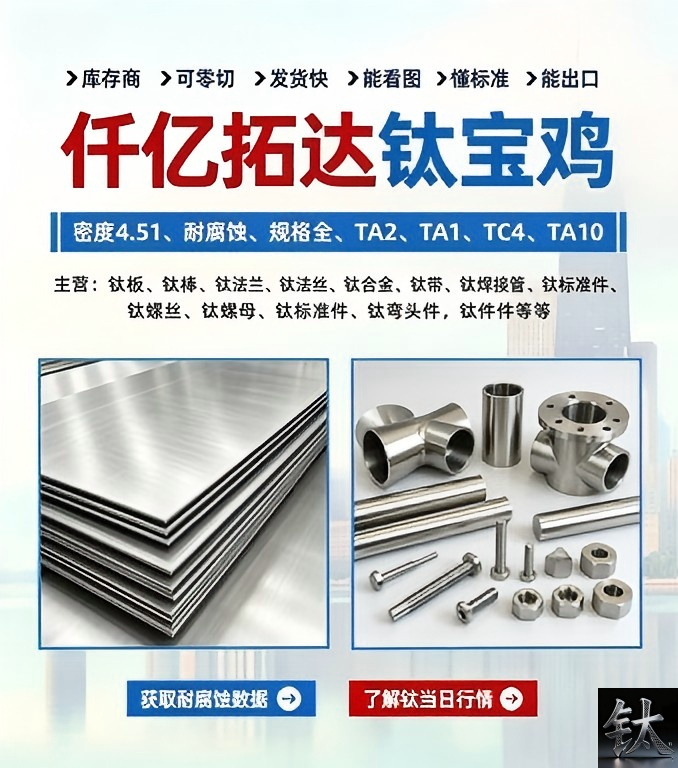
Tell us your requirement — grade, size and quantity. We reply within 24 hours.
Prefer chat? WhatsApp +86 188 2967 9311 or email sales@sxqytd.com.
- Titanium Price Today (23 Oct 2026): Plate, Tube, Rod & Wire
- Read titanium wire and titanium alloy wire: diameter classification
- Titanium wire: from brand selection to manufacturing process (2026 r
- Read titanium tube and titanium alloy tube: OD classification + comm
- Titanium pipe knowledge·tee + reducer selection 5 steps
Contact Person: Wang Xiaoning
Tel: +86-917-355-7966
Email: sales@sxqytd.com
WhatsApp: +86 188 2967 9311
Company: Shaanxi Qianyi Tuoda Technology Co., Ltd
Address: Floor 4, Building 4, No. 188 Gaoxin Avenue, High-tech Zone, Baoji City, Shaanxi Province, China