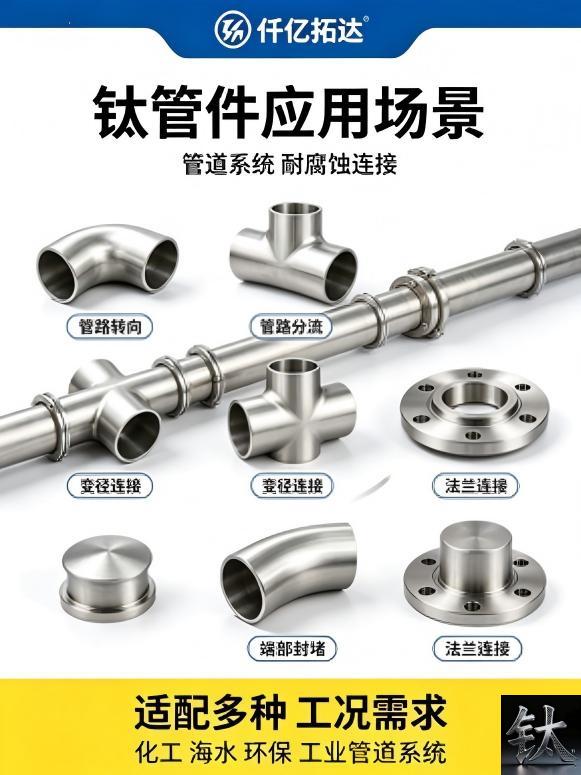
Titanium Fittings: ASTM B363 Procurement Guide
| Specification | ASTM B363 (wrought fittings), B16.9 (dimensions), B16.25 (bevel), B16.28 (short-radius elbows) |
|---|---|
| Applicable Standard | Gr1, Gr2, Gr3, Gr7, Gr9, Gr12, Gr16 — match fitting grade to pipe grade |
| Material Condition | Butt-welding pipe fittings for corrosive fluid piping — PTA, chlor-alkali, seawater, organic acid |
| Inspection & Packaging | Match fitting schedule to pipe (Sch 10S/40S/80S); verify elbow extrados wall by UT; require pickling after forming to remove iron contamination |
| Reference Price | $20.00 – $30.00 |
Product Description: ASTM B363 titanium butt-welding fittings: elbow extrados thinning, schedule matching, iron contamination control, wrought vs fabricated, lap joint stub end economics. Buyer guide with 8-field PO check
Product Overview
| Standards | ASTM B363 (wrought fittings), ASME B16.9 (dimensions), B16.25 (bevel ends), B16.28 (short-radius elbows) |
|---|---|
| Grades | Gr1, Gr2, Gr3, Gr7, Gr9, Gr12, Gr16 — butt-welding fitting grade must match pipe grade |
| Service | Butt-welding pipe fittings for corrosive fluid piping — PTA, chlor-alkali, seawater, organic acid, condensate |
| Core distinction | B363 is the material spec; B16.9 is the dimension spec. Specifying only B16.9 means accepting any material. Schedule mismatch and extrados thinning are the two failure roots. |
The Failure: 11 Months to Pinhole in a 90° LR Elbow
In 2022, a coastal PTA (purified terephthalic acid) plant in China commissioned a 6-inch Sch 10S Gr2 titanium pipeline carrying acetic acid condensate at 85°C. The line used standard B363 90° long-radius elbows ordered on a purchase order that read only "B363 Gr2 elbow 6" Sch 10S LR, 90°" — eleven months later, a pinhole leak appeared at the 3 o'clock position on the extrados (outer radius) of an elbow downstream of a control valve. The line had operated at design pressure and temperature, with no upset events.
Metallurgical investigation found the extrados wall measured 2.67 mm at the leak site. The nominal wall for Sch 10S 6-inch pipe is 3.05 mm. The fitting had been formed from welded tube stock, and two compounding effects had reduced the wall: (a) the mill tolerance allowed under B363 permits -12.5% from nominal, giving a floor of 2.67 mm; (b) the forming process had stretched the extrados an additional 8-12%. The buyer's specification did not require UT verification of the extrados after forming, and the supplier had delivered at the B363 floor — perfectly legal, but useless for the service.
The lesson is not that B363 is defective. The lesson is that "B363 Gr2 Sch 10S" is not a purchase order — it is a starting point. A complete titanium fitting purchase order has eight fields, not three, and the missing five are where the failures live.
ASTM B363 Scope: What It Covers and What It Does Not
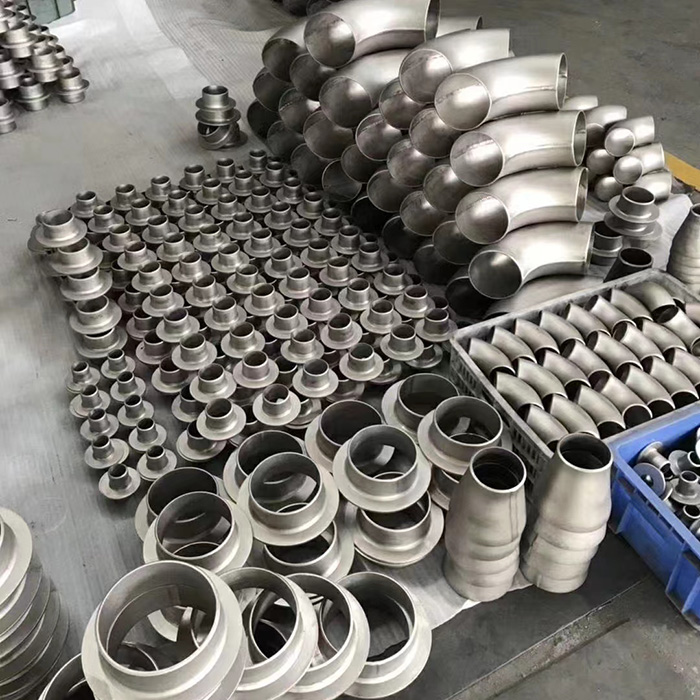
ASTM B363 covers wrought titanium and titanium-alloy butt-welding fittings for general corrosion-resisting service. The fitting types within scope are elbows (45°, 90°, 180°; long radius and short radius), tees (equal and reducing), concentric and eccentric reducers, caps, and stub ends (lap joint). B363 specifies the chemistry, mechanical properties, hydrotest requirements, dimensional tolerances per ASME B16.9, bevel end preparation per B16.25, and surface finish requirements. It does not cover fabricated fittings (built up by welding plate), nor does it cover threaded or socket-weld fittings.
The standard's scope explicitly addresses titanium-specific concerns that B16.9 alone does not: hydrogen pickup control, iron contamination prevention, post-forming pickling, and surface inspection for embedded foreign material. A buyer who specifies "ASME B16.9 fitting" on a titanium purchase order has technically accepted any material that meets B16.9 dimensions — including carbon steel. For titanium service, B363 plus the grade (e.g., B363 Gr2) is the minimum citation.
Wrought vs Fabricated: The 12-Inch Boundary
Wrought B363 fittings are formed from seamless tube, welded tube, plate, or bar stock in a single piece — there are no welds in the fitting body except the original tube seam if made from welded stock. Wrought fittings have continuous grain flow, predictable mechanical properties, and the lowest residual stress. Standard wrought B363 availability extends to 12-inch (DN300) in most common geometries; above 12-inch, wrought B363 becomes scarce and expensive.
Fabricated fittings are built up by welding multiple plate pieces together. A fabricated tee is three plate pieces joined by three full-penetration welds; a fabricated elbow is two halves of a cut plate welded at the spine and belly. Fabricated fittings are not covered by B363 and must be qualified under ASME B31.3 with WP-grade welder qualifications, full NDT on all welds, and post-weld heat treatment is generally not required for titanium but post-weld pickling is mandatory.
For service below 12-inch, always specify wrought B363. For 14-inch and above where wrought is unavailable, fabricated is the industry standard — but expect 30-50% lower fatigue life and require 100% UT or RT on all fabrication welds. The buyer who accepts a "B363 equivalent" fabricated fitting below 12-inch without the B31.3 qualification package is buying a future leak.
Elbow Extrados Thinning: The -12.5% × Forming Trap
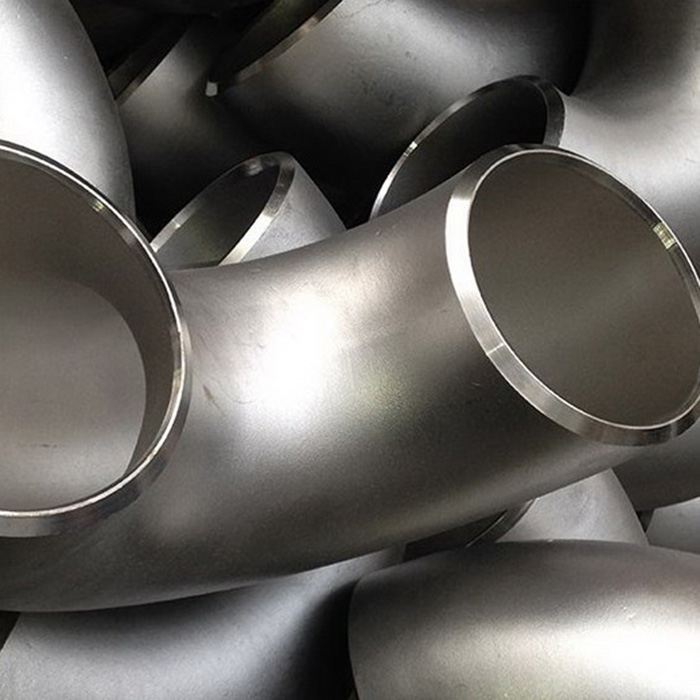
The single most common B363 failure mode is extrados thinning on formed elbows. The mechanism is straightforward: during the cold or hot forming of an elbow, the outer radius (extrados) stretches under tensile stress while the inner radius (intrados) compresses. The extrados wall reduces by 8-15% depending on the radius ratio and forming method; the intrados thickens by a similar amount.
Compounding this is the B363 mill tolerance, which permits -12.5% from nominal wall on the fitting as-supplied. A fitting formed from tube at the -12.5% floor, with an additional 10% forming reduction at the extrados, can measure as low as 0.875 × 0.90 = 0.788 × nominal wall at the thinnest point. On Sch 10S 6-inch (nominal 3.05 mm), this gives 2.40 mm — 21% below the nominal design basis.
Standard B363 default NDT does not require UT on the extrados. Buyers must add this on the purchase order: "Ultrasonic thickness measurement at four points on the extrados (0°, 90°, 180°, 270° from the weld bevel), minimum measured wall shall not be less than 87.5% of nominal schedule wall." Suppliers will charge 3-5% premium for this verification; the cost of not specifying it is a pinhole leak in 11 months.
Schedule Matching: Sch 10S, 40S, 80S
Titanium butt-welding fittings are supplied in the same schedule designations as titanium pipe: Sch 10S (light wall), Sch 40S (standard wall), Sch 80S (extra heavy). The fitting schedule must match the pipe schedule exactly — not approximately. The pipe ID and fitting ID at the weld bevel must be continuous; any step creates turbulent flow at the weld root, which in titanium service accelerates crevice corrosion in the heat-affected zone.
| Schedule | 6-inch Wall (mm) | Typical Service |
|---|---|---|
| Sch 10S | 3.05 | Low-pressure corrosive fluid, condensate |
| Sch 40S | 3.68 | Standard chemical service, ASME B31.3 Normal Fluid Service |
| Sch 80S | 5.54 | High-pressure cyclic, severe erosion service |
The most common schedule-matching error is ordering pipe in Sch 10S and fittings in Sch 40S (or vice versa), particularly when pipe and fittings are ordered from different suppliers. The Sch 40S fitting welded to a Sch 10S pipe creates a 0.63 mm ID step at the weld root — small, but sufficient to generate a low-pressure recirculation zone in turbulent flow and initiate crevice corrosion in the HAZ within 18 months. Specify the schedule on every line item of the purchase order and verify on receipt with a vernier at the bevel face.
Grade Selection: Matching the Fitting to the Pipe
Butt-welding fitting grade must match pipe grade. The grades available under B363 mirror B338 tube grades: Gr1, Gr2, Gr3 (commercially pure), Gr7 (Ti-0.15Pd, UNS R52400), Gr9 (Ti-3Al-2.5V, UNS R56901), Gr12 (Ti-0.3Mo-0.8Ni, UNS R53400), and Gr16 (low-Pd variant of Gr7). The baseline grade for general corrosive service is Gr2 — UNS R50400, equivalent to Chinese TA2.
Three grade-matching rules are mandatory. First, a Gr2 fitting welded to a Gr7 pipe is not a cost-saving compromise — it is a galvanic mismatch. The Gr7 zone (high palladium) was chosen because the service conditions cause active corrosion on Gr2; welding a Gr2 fitting into that line places a less-noble material in the most-stressed location (the weld HAZ), guaranteeing failure at the fitting. Second, Gr7 and Gr12 fittings must be PMI-tested on every lot because they differ from Gr2 by only 0.15% Pd or 0.3% Mo + 0.8% Ni — invisible to the eye and easily confused in inventory. Third, Gr9 (Ti-3Al-2.5V) is the only grade in the list with significant aluminum content; it should not be specified where titanium's weldability to CP grades is a primary assumption, because the Gr9 weld zone has different mechanical properties from the CP-grade HAZ.
Iron Contamination: The Tooling Trap
Titanium's corrosion resistance depends on a stable TiO2 passive film. Free iron particles embedded in the surface from carbon steel tooling, grinding wheels, wire brushes, or handling with carbon steel tongs disrupt that film locally and create a galvanic cell: the iron particle is anodic to the titanium, pitting initiates at the particle, and the pit propagates into the wall. This is not a theoretical concern — it is the second most common cause of titanium fitting failure after extrados thinning.
B363 manufacturers producing fittings for corrosive service must use dedicated titanium tooling or stainless steel tooling (never carbon steel), and fittings must be pickled in an HF/HNO3 bath after forming to remove embedded iron and surface contamination. The pickle also removes the alpha case — the brittle oxygen-enriched surface layer that forms above 500°C. Buyers should require on the PO: "Fittings shall be pickled after forming; free iron test per ASTM A380 shall be performed on 10% of fittings per lot; failure requires 100% re-pickling." Suppliers who do not pickle by default will deliver fittings with embedded iron that pass visual inspection and fail in 6-24 months.
B16.9 Dimensions vs B363 Material: The Two-Specification Trap
ASME B16.9 specifies the dimensions (center-to-face, wall thickness schedule, bevel geometry, weight tolerances) for butt-welding fittings of any material. ASTM B363 specifies the material requirements (chemistry, mechanical, surface, NDT, titanium-specific concerns) plus incorporates B16.9 by reference for dimensions. A titanium fitting conforms to both — it has B16.9 dimensions and B363 material properties.
Buyers frequently cite only B16.9 on purchase orders, assuming the supplier will default to titanium because the order is for titanium. This assumption is incorrect. B16.9 alone accepts any material — carbon steel, stainless, alloy steel, or titanium — that meets the dimensional standard. A complete titanium fitting PO must cite B363 plus the grade: "ASTM B363 Grade 2, dimensions per ASME B16.9, bevel per B16.25." Without B363, the supplier has no contractual obligation to verify titanium chemistry, surface contamination, or hydrogen pickup.
Lap Joint Flange + Stub End: The Cost Architecture
For piping above 2-inch where flanged joints are required, the lap joint flange + stub end system is the standard titanium piping architecture. The stub end is a short B363 fitting (titanium) that is butt-welded to the titanium pipe; the backing flange ring is a loose ring that slides over the stub end and bolts to the mating flange. The flange ring can be carbon steel or stainless, because it does not contact the process fluid — only the stub end does.
The economics are decisive. A 6-inch titanium weld neck flange weighs approximately 9 kg and costs the full titanium material price. A 6-inch titanium stub end weighs approximately 1.5 kg; a carbon steel slip-on flange ring of the same pressure class weighs 8 kg and costs roughly 1/8 the titanium equivalent. The lap joint + stub end system delivers 60-80% flange cost savings on diameters above 2-inch, with the additional benefit that the backing ring tolerates bolt-hole misalignment better than a rigid weld neck.
Weld neck Titanium Flanges are reserved for high-pressure cyclic service, severe erosion service, or where the flange face is directly exposed to the process fluid (e.g., a flange at the end of a spool with no stub end). The buyer who specifies titanium weld neck flanges across a 6-inch pipeline for "uniformity" is buying 4-6x the flange material cost without service benefit.
Bevel Ends and Welding Preparation per B16.25
ASME B16.25 specifies the bevel end preparation for butt-welding fittings: a 37.5° bevel angle with a 1.6 mm root face (the "land") for wall 4.8 mm and thicker; for thinner wall, a plain square cut or a slight chamfer without root face. The bevel must be free of oxide, grease, moisture, and embedded iron before welding — titanium TIG welding requires cleanliness levels approaching surgical-grade, because titanium dissolves oxygen and nitrogen from the atmosphere above 500°C and becomes embrittled.
Suppliers should deliver B363 fittings with bevels prepared, deburred, and passivated. Buyers should inspect the bevel face on receipt: any discoloration (blue, purple, or grey straw color) indicates oxygen contamination from bevel cutting with a hot grinding wheel; the affected layer must be removed by mechanical means or pickling before welding. Bevels cut with a cold-cut saw or band saw are preferred; bevels cut with an abrasive wheel generate heat and require additional surface removal.
Tolerance, Out-of-Round, and Wall Verification
B363 and B16.9 specify tolerance envelopes for fitting dimensions: wall thickness (-12.5% from nominal, the mill tolerance), out-of-roundness (the fitting end must be round within 1% of nominal OD for sizes up to 12-inch), center-to-face dimension (±1.6 mm for 90° and 45° elbows up to 10-inch), and bevel angle (±2.5°). These tolerances are designed for normal fluid service; they are not sufficient for high-cyclic or high-temperature service without additional verification.
Buyers should add three verification steps to the PO for severe service. First, UT on the extrados of formed elbows — the supplier measures wall at four positions (0°, 90°, 180°, 270°) and reports the minimum; the minimum must not fall below 87.5% of nominal. Second, PT (liquid penetrant testing) on the bevel face and inside surface within 25 mm of the bevel — this catches surface-breaking cracks from forming or handling. Third, dimensional check on receipt: verify OD at the bevel, wall at the bevel face, center-to-face on a sample of 10% of the lot, and schedule match against the mating pipe — a fitting marked "Sch 10S" that measures 3.68 mm wall at the bevel is a Sch 40S mislabel.
Eight Common Procurement Failures
These are the eight failures observed in B363 purchase orders over the past decade, in approximate frequency order:
1. Citing only B16.9 without B363. The supplier has no contractual obligation to verify titanium chemistry, surface contamination, or hydrogen pickup. Carbon steel fittings can be delivered as "compliant" and the buyer has no recourse. Always cite "B363 Gr[grade], dimensions per B16.9."
2. Not specifying minimum extrados wall. B363 allows -12.5% from nominal plus forming thinning of 10-15%. Without a UT verification requirement on the extrados, the supplier can deliver at the B363 floor and the buyer carries the risk. Add "UT on extrados, minimum 87.5% of nominal" to every elbow PO.
3. Schedule mismatch between pipe and fittings. Sch 40S fitting welded to Sch 10S pipe creates a 0.6 mm ID step at the weld root, generating turbulent flow and crevice corrosion. Verify schedule match on receipt with a vernier at the bevel face.
4. Grade mismatch. Gr2 fitting welded to Gr7 pipe (or vice versa) creates a galvanic mismatch at the weld. Fit welds cross-grade to the less-noble material, which is the wrong place to compromise. The fitting grade must equal the pipe grade.
5. Not requiring pickling after forming. Free iron embedded from carbon steel tooling initiates pitting. Require "pickled after forming, free iron test per ASTM A380 on 10% of lot" on every PO.
6. Accepting "B363 equivalent" fabricated fittings below 12-inch. Fabricated fittings are not B363 — they have lower fatigue life and no B363 traceability. Below 12-inch, always require wrought B363.
7. Not requiring PMI on Gr7, Gr12, Gr16. These grades differ from Gr2 by 0.15% Pd or 0.3% Mo + 0.8% Ni — invisible to the eye. Require PMI (XRF) on every lot, not random sampling.
8. Specifying titanium weld neck flanges where lap joint + stub end would do. 4-6x the flange cost without service benefit. Reserve weld neck for high-pressure cyclic or direct-fluid-exposure service.
Cost Economics: Where the Money Goes
A 6-inch Sch 10S Gr2 titanium pipeline priced per meter of installed spool breaks down approximately as follows (illustrative, based on 2024-2026 producer and trader quotations for finished mill products):
| Component | Cost per Meter (USD) | Share |
|---|---|---|
| Gr2 Sch 10S pipe (6") | $55-70 | 45% |
| B363 Gr2 90° LR elbow | $180-240 each (every ~12 m) | 22% |
| B363 Gr2 equal tee | $220-300 each (every ~30 m) | 11% |
| Stub end + CS lap joint flange | $90-130 per joint (every ~30 m) | 7% |
| Welding, NDT, pickling labor | $25-40 | 15% |
Fittings are 40% of installed cost on 22% of installed length. The lever for cost reduction is not pipe price — it is fitting specification discipline. Specifying minimum extrados wall (5% fitting premium) prevents an 11-month leak; requiring pickling (2-3% fitting premium) prevents iron-contamination pitting; specifying lap joint + stub end instead of weld neck (60-80% flange savings) cuts flange costs on large diameters. The buyer who treats fittings as a commodity line item forfeits these levers.
Supplier Verification: Six Documents to Request
Before placing a B363 fitting order, request these six documents. A supplier who cannot produce all six is not qualified for titanium butt-welding fitting service.
1. Material Test Report (MTR) per EN 10204 3.1 or 3.2, showing heat chemistry, mechanical properties, and UNS designation matching the ordered grade.
2. B363 compliance certificate stating the fittings are manufactured to ASTM B363 with grade verification, not "B16.9 dimensions only."
3. Pickling certificate or process traveler showing the HF/HNO3 bath step was performed after forming, with ASTM A380 free-iron test results on 10% of the lot.
4. UT extrados wall verification report for every elbow in the order, showing four-point measurement and minimum wall.
5. Hydrotest report at 1.5× design pressure per B363 for every fitting (standard, but verify it was performed and not skipped).
6. PMI (XRF) certificate for every lot of Gr7, Gr12, or Gr16 fittings, verifying the palladium, molybdenum, or nickel content matches the grade specification.
Summary: The 8-Field Purchase Order for Titanium Fittings
A complete B363 titanium butt-welding fitting purchase order has these eight fields. Anything less leaves a gap the failure will find.
1. Standard + grade: ASTM B363 Gr2 (or Gr7/Gr12/Gr16), UNS R50400 (or R52400/R53400/R52402), dimensions per ASME B16.9, bevel per B16.25.
2. Geometry: 90° LR elbow / 45° SR elbow / equal tee / concentric reducer (6"×4") / eccentric reducer (6"×4") / cap / stub end.
3. Size + schedule: NPS 6, Sch 10S (matching pipe schedule). Specify both.
4. Wall verification: UT on extrados at 4 positions (0°, 90°, 180°, 270°), minimum wall 87.5% of nominal.
5. Surface condition: Pickled after forming; free-iron test per ASTM A380 on 10% of lot.
6. NDT: Visual + hydrotest per B363 (default); add PT on bevel and inside 25 mm for severe service.
7. Documentation: MTR EN 10204 3.1, B363 compliance certificate, pickling certificate, UT extrados report, hydrotest report, PMI certificate (for Gr7/Gr12/Gr16).
8. PMI on receipt: For Gr7, Gr12, Gr16 — buyer verifies XRF on 10% of received fittings before installation.
Frequently Asked Questions
Q1: What is the difference between ASTM B363 and ASME B16.9 for Titanium Fittings?
B363 is the material specification for wrought titanium butt-welding fittings. B16.9 is the dimensional specification for butt-welding fittings of any material. A B363 fitting conforms to B16.9 dimensions plus titanium-specific requirements (chemistry, mechanical, surface, hydrogen control, NDT). Specifying only B16.9 means you accept any material — for titanium you must cite B363 plus the grade.
Q2: Why does the elbow extrados wall thin and how much can it thin?
During forming, the outer radius (extrados) of an elbow stretches and thins while the inner radius (intrados) compresses and thickens. B363 allows -12.5% from nominal wall (mill tolerance). Combined with forming thinning of 10-15%, the actual extrados wall can reach 0.875 × nominal. On Sch 10S 6-inch pipe (nominal 3.05 mm), the extrados may measure 2.67 mm — below design minimum. Buyers must specify minimum wall or request UT verification on the extrados.
Q3: Can I use carbon steel tooling to form or handle Titanium Fittings?
No. Carbon steel tooling, grinding wheels, wire brushes, or even handling with carbon steel tongs embeds free iron particles into the titanium surface. In service, iron particles create local galvanic cells that initiate pitting and accelerate crevice corrosion. B363 manufacturers must use dedicated titanium tooling or stainless tooling, and fittings must be pickled (HF/HNO3 bath) after forming to remove embedded iron and surface contamination.
Q4: What is the difference between wrought (B363) and fabricated Titanium Fittings?
Wrought B363 fittings are formed from seamless tube, welded tube, plate, or bar stock in a single piece — no welds in the fitting body except the original tube weld if from welded stock. Fabricated fittings are built up by welding multiple plate pieces together (e.g., a fabricated tee = three plate pieces welded). B363 does not cover fabricated fittings. For large diameters above 12 inch (DN300) where wrought B363 is unavailable, fabricated fittings per ASME B31.3 with WP-grade welder qualifications are used, but with reduced fatigue life and additional NDT.
Q5: How do I match fitting grade and schedule to the pipe?
Two matches required: (1) Grade match — butt-weld fitting UNS and grade must equal the pipe (Gr2 pipe + Gr2 fitting, Gr7 pipe + Gr7 fitting). A Gr2 fitting welded to Gr7 pipe creates a galvanic mismatch at the weld and reduces the corrosion allowance of the high-Pd zone. (2) Schedule match — pipe Sch 10S goes with Sch 10S fitting, Sch 40S with Sch 40S, Sch 80S with Sch 80S. Mismatched schedule creates an ID step at the weld root, causing turbulent flow and crevice corrosion.
Q6: When should I use a lap joint flange with stub end instead of a weld neck flange?
Lap joint flange + stub end is preferred for titanium piping above 2 inch when cost matters. The stub end (short B363 fitting) is titanium; the backing flange ring can be carbon steel or stainless. This saves 60-80% of flange cost on large diameters because only the stub end carries the corrosive fluid. Weld neck flanges require the entire flange body to be titanium — 4-6x the cost of a stub end + CS ring. Use weld neck only for high-pressure cyclic service or where the flange face is exposed to fluid.
Q7: What NDT is required on B363 Titanium Fittings before shipment?
B363 default NDT is visual inspection plus hydrotest at 1.5x design pressure. For service above 60C, chloride service, or fatigue/cyclic service, buyers must add: (1) UT on elbow extrados to verify minimum wall; (2) PT (liquid penetrant) on all weld bevels and formed surfaces for surface-breaking cracks; (3) ET on seamless-stock fittings for longitudinal defects. PMI (XRF) on every lot of Gr7, Gr12, Gr16 — these grades differ from Gr2 by only 0.15% Pd or 0.3% Mo + 0.8% Ni, invisible to the eye.
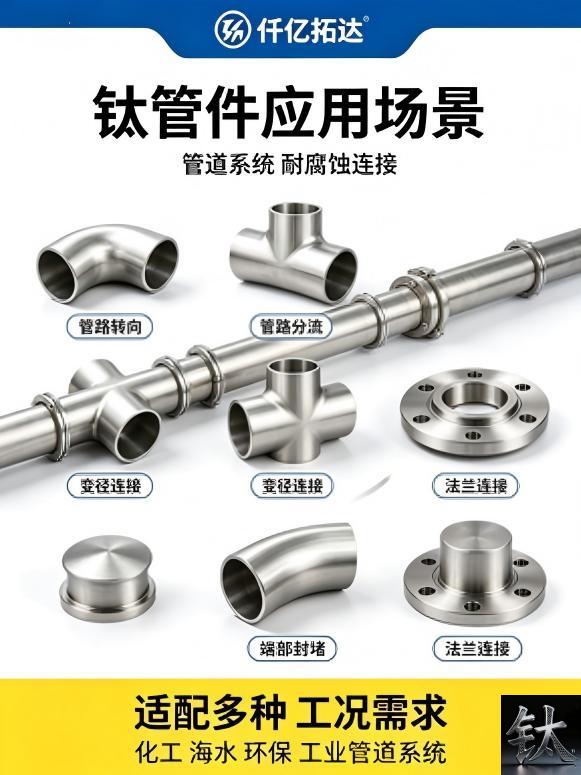
Tell us your requirement — grade, size and quantity. We reply within 24 hours.
Prefer chat? WhatsApp +86 188 2967 9311 or email sales@sxqytd.com.
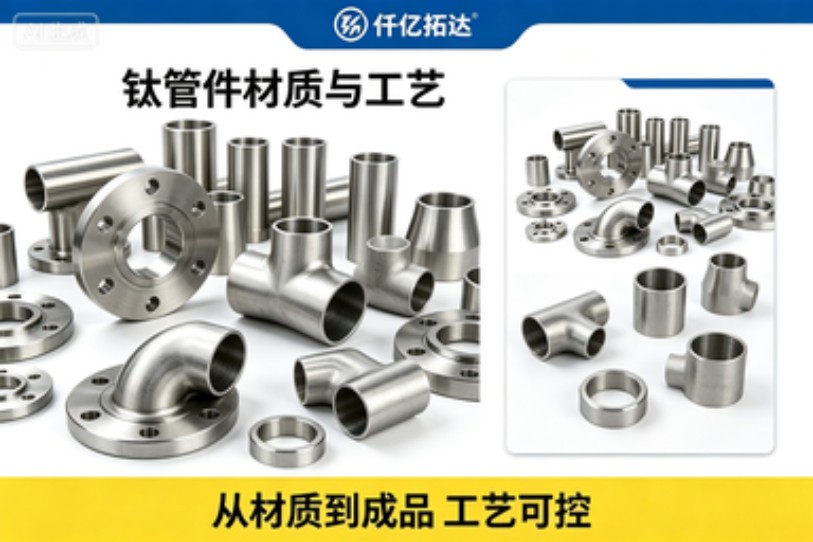
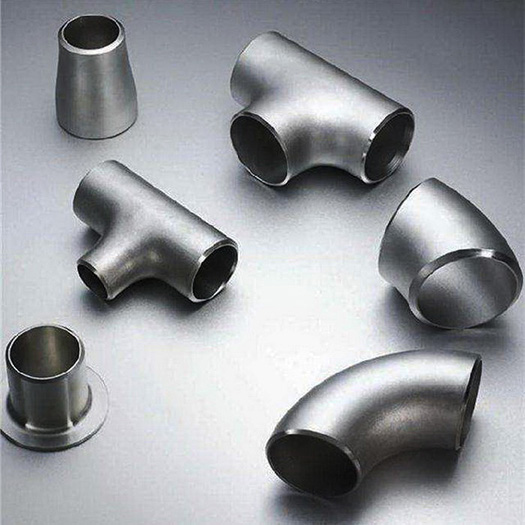
- Titanium Price Today (23 Oct 2026): Plate, Tube, Rod & Wire
- Read titanium wire and titanium alloy wire: diameter classification
- Titanium wire: from brand selection to manufacturing process (2026 r
- Read titanium tube and titanium alloy tube: OD classification + comm
- Titanium pipe knowledge·tee + reducer selection 5 steps
Contact Person: Wang Xiaoning
Tel: +86-917-355-7966
Email: sales@sxqytd.com
WhatsApp: +86 188 2967 9311
Company: Shaanxi Qianyi Tuoda Technology Co., Ltd
Address: Floor 4, Building 4, No. 188 Gaoxin Avenue, High-tech Zone, Baoji City, Shaanxi Province, China