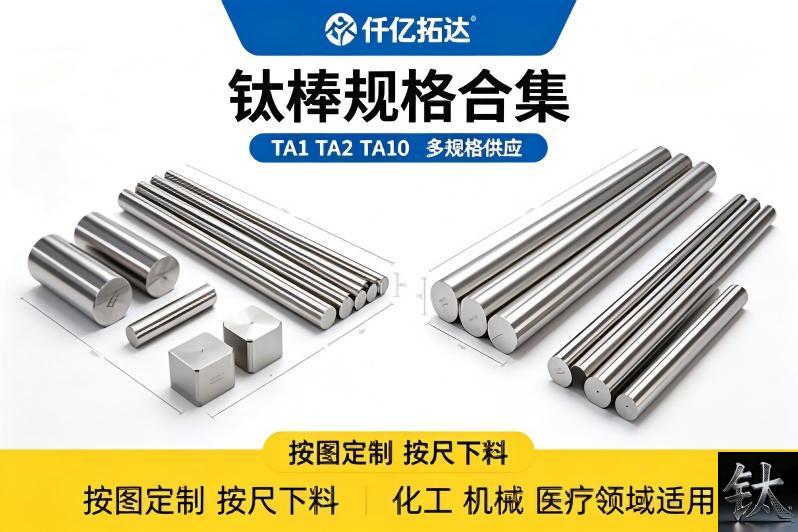
Titanium Bar — ASTM B348 Surface, NDT & Grade Guide
| Specification | ASTM B348 (bar), B381 (forgings), F67 (CP implant), F136 (Ti-6Al-4V ELI implant) |
|---|---|
| Applicable Standard | Gr1, Gr2, Gr3, Gr5, Gr7, Gr9, Gr12, Gr23 — baseline Gr2 (CP) and Gr5 (Ti-6Al-4V) |
| Material Condition | Aerospace fasteners, medical implants, marine shafting, chemical pump spindles |
| Inspection & Packaging | Specify NDT for fatigue/implant service; remove alpha case before machining; Gr23 not Gr5 for medical; forged for cyclic duty |
| Reference Price | $10.00 – $15.00 |
Product Description: ASTM B348 titanium bar guide: alpha case removal, forged vs rolled grain flow, diameter tolerance, UT NDT for bars, Gr5 vs Gr23 oxygen content, 7 procurement traps.
Product Overview
| Standards | ASTM B348 (bar); B381 (forgings); F67 (CP implant); F136 (Ti-6Al-4V ELI implant) |
| Grades | Gr1, Gr2, Gr3, Gr5, Gr7, Gr9, Gr12, Gr23 — baseline Gr2 (CP) and Gr5 (Ti-6Al-4V) |
| Service | Aerospace fasteners, medical implants, marine shafting, chemical pump spindles |
| Core distinction | B348 covers bars; B381 covers forgings. Rolled bar has isotropic transverse properties; forged bar has directionally-strengthened grain flow. Alpha case must be removed before machining or weld-cracking follows. |
The Case: A Spinal Implant Recall from Subsurface Defects
In 2020, a European spinal implant manufacturer recalled a lot of pedicle screws machined from Gr23 (Ti-6Al-4V ELI) titanium bar. The recall was triggered by a post-market surveillance finding: three patients had screw fracture at the thread root within 18 months of implantation, in service that the implant was designed to withstand for 15 years. The fracture surfaces showed fatigue crack initiation at a subsurface inclusion — a titanium nitride particle roughly 80 micrometers across, 200 micrometers below the surface.
The bar had been purchased as "ASTM B348 Gr23." The mill had furnished a UT certificate showing the bar met the default B348 NDT level. The default B348 UT is calibrated to catch gross defects — long internal tears, large pores — not the smaller inclusions that become stress risers in an implant operating at 10 million fatigue cycles per year of walking. The implant manufacturer had not specified ASTM E2375 UT at the implant-grade sensitivity, because the buyer did not know that B348 had a default UT level distinct from the implant-grade UT level.
This case is the bar equivalent of the 8-month condenser tube failure described in the B338 guide. The bar was genuine Gr23, correctly certified to B348. The failure was a specification failure. The buyer wrote a grade and a standard and assumed that was a complete purchase order. It was not. This guide exists so that your next B348 purchase order — whether for a spinal implant or a pump spindle — does not end the same way.
ASTM B348 Scope: Bars, Not Forgings
ASTM B348 is titled "Standard Specification for Titanium and Titanium Alloy Bars and Billets." The word that does the work is bars. B348 covers straight-length product in rectangular, round, hexagonal, or square cross-section, produced by rolling, forging, or cold drawing, supplied in semi-finished condition for the buyer to machine. B348 does not cover forgings — near-net-shape parts produced by closed-die or open-die forging — which are governed by ASTM B381.
The distinction matters for two reasons. First, the grain-flow pattern is different. A rolled bar has grain flow that runs longitudinally along the bar length; transverse properties are roughly isotropic but are not optimized to any direction. A forged bar has grain flow that follows the reduction direction of the forging, which can be oriented to follow the service stress in the finished part. For a fatigue-critical fastener, the grain flow must follow the head-to-shank contour, which only forging achieves.
Second, the NDT defaults differ. B348 specifies UT at a default sensitivity calibrated to catch gross defects. B381, recognizing that forgings typically serve in more demanding applications, defaults to a higher UT sensitivity. A purchase order that writes "B348 Gr5" when the design assumes a forging-grade UT will receive a bar with a lower NDT floor than the design assumed.
The rule: for general fabrication, B348 bar is correct. For fatigue-critical, cyclic, or implant service, specify B381 forging, or specify B348 with an upgraded UT level per ASTM E2375. Do not let the mill choose the NDT level by default.
Hot-Rolled vs Cold-Drawn vs Cold-Worked Surface Conditions
B348 bar is supplied in three principal surface conditions: hot-rolled, cold-drawn (also called cold-worked), and ground. Each condition carries a different combination of dimensional tolerance, surface finish, and residual stress, and each is suited to a different downstream use.
Hot-rolled bar is produced by rolling a heated billet through a rolling mill. The surface is dark gray to black, with a thin oxide scale and the underlying alpha case. Diameter tolerance is typically h11 to h13 — on a 25 mm bar, that is plus 0 / minus 0.13 to minus 0.33 mm. Hot-rolled is the baseline condition for general fabrication; it is stress-relieved, isotropic, and the least expensive route. The buyer must remove the alpha case (0.5 to 1.5 mm per side) before service.
Cold-drawn bar is produced by drawing hot-rolled bar through a die at room temperature. The surface is bright, with a ground or polished finish. Diameter tolerance is typically h9 to h10 — on a 25 mm bar, that is plus 0 / minus 0.052 to minus 0.084 mm. Cold-drawn is specified when the machining stock allowance must be minimized — precision turning, Swiss-type machining, medical implant bar where every gram of chip is wasted margin. The catch: cold-drawn bar carries residual cold-work stress that can distort during machining; specify stress-relief annealing after drawing if the part tolerance is tight.
Ground bar is cold-drawn or turned bar that has been centerless-ground to a final tolerance, typically h8 to h9, with a surface finish better than 0.8 micrometers Ra. Ground bar is the precision product, used for pump shafts, valve stems, and bearing journals where the surface is the final surface. The premium over hot-rolled is 30 to 80 percent.
| Condition | Tolerance (25mm) | Surface finish | Typical use |
| Hot-rolled, pickled | h11-h13 (-0.13 to -0.33 mm) | Dark, oxide removed | General fabrication |
| Cold-drawn | h9-h10 (-0.052 to -0.084 mm) | Bright, drawn | Precision machining stock |
| Ground | h8-h9 (-0.033 to -0.052 mm) | Polished, < 0.8 µm Ra | Shafts, journals, bearings |
The Alpha Case Problem: Why Surface Condition Matters
Titanium reacts with oxygen above roughly 500 °C. When a bar is hot-rolled or forged in air, oxygen diffuses into the surface and stabilizes the alpha phase, forming a brittle, oxygen-enriched layer called the alpha case. The alpha case is hard — typically 400 to 600 HV versus 200 to 300 HV for the substrate — but it has near-zero ductility. Under load, it cracks. The cracks propagate into the ductile substrate and become fatigue or fracture initiation sites.
The alpha case is invisible to the eye on a pickled bar; the dark oxide scale has been removed, but the oxygen-enriched layer beneath remains. The only reliable detection is a microhardness traverse on a cross-section. B348 requires the supplier to disclose whether the alpha case has been removed; it does not require removal by default. A bar furnished "hot-rolled, pickled" has the oxide scale removed but may retain the alpha case.
Removal is by machining, grinding, or pickling to a depth of 0.5 to 1.5 mm per side, depending on bar size and heating history. For a 25 mm bar, removing 1 mm per side reduces the usable diameter to 23 mm — a 17 percent section loss. Buyers who do not account for this in their machining stock allowance either machine into the alpha case (and produce cracked parts) or scrap the bar (and lose the material).
The rule: for any fatigue, fracture-critical, or implant service, specify "alpha case removed, depth verified by microhardness traverse per ASTM E384." For general fabrication with no cyclic load, "hot-rolled, pickled, alpha case as-supplied" is acceptable provided the fabricator machines it off before service. Do not assume "pickled" means "alpha case removed."
Diameter Tolerance: h9, h10, h11, and What They Mean
B348 diameter tolerance follows the ISO system of fits and tolerances, with the tolerance class depending on the manufacturing route. Hot-rolled bar is typically furnished h11 to h13. Cold-drawn is h9 to h10. Ground is h8 to h9. The class designation is critical because it determines the minimum diameter the mill can ship and the maximum machining stock the buyer must remove.
On a 25 mm nominal bar: h9 is plus 0 / minus 0.052 mm, meaning the bar can arrive anywhere from 24.948 to 25.000 mm. h11 is plus 0 / minus 0.13 mm, meaning 24.870 to 25.000 mm. h13 is plus 0 / minus 0.33 mm, meaning 24.670 to 25.000 mm. If the machining stock allowance assumes 25.000 mm nominal and the bar arrives at the low end of h13, the first turning pass removes 0.33 mm of stock that the allowance did not budget for.
For precision machining — Swiss-type turning, medical implant machining, pump spindle finishing — the tolerance class must be specified on the purchase order. The default B348 tolerance depends on the manufacturing route and may be wider than the machining stock allowance assumes. Specify h9 for cold-drawn ground bar, h11 for hot-rolled pickled, and h8 for centerless-ground bar. Do not specify just "25 mm diameter"; specify "25 mm diameter, h9 tolerance."
The cost premium for tighter tolerance is small in absolute terms — typically 5 to 15 percent over hot-rolled for cold-drawn, and 30 to 80 percent for ground — but the assurance that the bar arrives within the machining stock allowance is what makes the production line run without rework.
NDT for Bars: UT Mandatory, ET Optional
Ultrasonic testing is the principal NDT method for titanium bar, because the defects that matter in bar service — center porosity, subsurface inclusions, internal tears — are not surface-breaking and are not reliably caught by eddy current. B348 specifies UT as the baseline NDT method for bar above a certain diameter; the default sensitivity class is calibrated to ASTM E2375 reference standards.
The critical point is that B348 UT is a floor, not a ceiling. The default reference standard catches defects of a certain minimum size — typically long tears and large pores — but does not catch smaller inclusions that become stress risers in cyclic or implant service. For those applications, ASTM E2375 specifies higher sensitivity classes with smaller reference standards, calibrated to detect smaller defects.
The spinal implant recall described at the start of this guide turned on this exact gap. The default B348 UT passed the bar; the implant-grade UT would have caught the 80-micrometer inclusion that became the fatigue initiation site. The buyer had not specified the implant-grade UT, because the buyer did not know that B348 had a default UT distinct from E2375 implant-grade UT.
Eddy current testing is supplementary. ET catches surface and near-surface defects — seams, laps, cracks — and is useful for inspecting cold-drawn bar where surface finish matters. ET does not replace UT for subsurface defects. For implant and aerospace service, require both: ET for surface, UT at the appropriate sensitivity class for subsurface.
Forged vs Rolled: Grain Flow and Implant Service
The difference between a rolled bar and a forged bar is not just the manufacturing route; it is the grain-flow pattern, which determines the fatigue performance of the finished part. A rolled bar has grain flow that runs longitudinally along the bar length. The longitudinal direction has high strength; the transverse direction is roughly isotropic but weaker. A forged bar has grain flow that follows the reduction direction of the forging die, which can be oriented to follow the service stress in the finished part.
For a fatigue-critical fastener — a bolt, a screw, a stud — the grain flow must follow the head-to-shank contour. The head fillet is the highest stress location in the fastener, and if the grain runs transversely at the fillet, the fatigue life is 30 to 60 percent lower than a forged equivalent. A rolled bar machined to a bolt shape has transverse grain at the head fillet; a forged heading or a forged bar has grain flow that follows the head-shank transition.
The rule: for fatigue-critical fastener service, specify forged bar (B381) or heading wire with controlled grain flow. For general fabrication with no cyclic load, rolled bar is acceptable. For medical implant service, specify forged bar with implant-grade UT — neither rolled bar nor default B348 UT is sufficient.
The cost premium for forged over rolled is 40 to 100 percent for the bar itself, but the premium is trivial against the cost of a fatigue failure. For a 100,000-unit fastener run at $2 per unit, the forged premium adds $80,000 to $200,000. A single field failure on a fatigue-critical fastener can cost $500,000 to $5 million in recall and liability. The economics favor forging for any service where the part sees cyclic load.
Grade Selection: Gr2, Gr5, Gr23, Gr12, Gr9
B348 lists nine grades. Five dominate bar procurement: Gr2, Gr5, Gr23, Gr12, and Gr9. The selection is driven by strength, fatigue requirement, and — for medical service — by the implant-grade chemistry limits.
Gr2 is commercially pure titanium, UNS R50400, broadly equivalent to Chinese TA2. It is the baseline for general fabrication: pump spindles, marine shafting, chemical fasteners where corrosion resistance matters more than strength. Minimum yield strength is 275 MPa. Gr2 bar is the lowest-cost product in the B348 range.
Gr5 is Ti-6Al-4V, UNS R56400, an alpha-beta alloy. It is the highest-volume titanium grade in aerospace and general engineering, used for fasteners, structural fittings, and pump shafts where strength-to-weight matters. Minimum yield strength is 828 MPa — three times Gr2. The cost premium over Gr2 is 1.5 to 2.5 times. Gr5 is the workhorse of the B348 grade list.
Gr23 is Ti-6Al-4V ELI, UNS R56401. The nominal composition is identical to Gr5 — 6 percent aluminum, 4 percent vanadium — but the oxygen limit is reduced from 0.20 to 0.13 percent. The lower oxygen gives higher fracture toughness and lower ductile-to-brittle transition temperature, which is why Gr23 is the medical implant grade per ASTM F136. The cost premium over Gr5 is 1.3 to 2.0 times, driven by the tighter chemistry limits and the additional quality control.
Gr12 is Ti-0.3Mo-0.8Ni, UNS R53400. A crevice-corrosion-resistant grade for chemical service, used where Gr2 would suffer crevice attack. Minimum yield is 345 MPa. The cost premium over Gr2 is 1.4 to 1.8 times.
Gr9 is Ti-3Al-2.5V, UNS R56901. A high-strength alpha-beta alloy, used for hydraulic tubing and aerospace structural bar. Minimum yield is 585 MPa. The cost premium over Gr2 is 2 to 3 times.
| Grade | Composition | Yield (MPa) | Service | Cost vs Gr2 |
| Gr2 | CP titanium | 275 | General fabrication, marine, chemical | 1.0× |
| Gr5 | Ti-6Al-4V | 828 | Aerospace fasteners, structural | 1.5-2.5× |
| Gr23 | Ti-6Al-4V ELI | 760 | Medical implants per F136 | 2.0-4.0× |
| Gr12 | Ti-0.3Mo-0.8Ni | 345 | Chemical crevice service | 1.4-1.8× |
| Gr9 | Ti-3Al-2.5V | 585 | Aerospace hydraulic, structural | 2.0-3.0× |
The Gr5 vs Gr23 Confusion: Oxygen Content and Medical ELI
The most dangerous grade confusion in titanium bar procurement is Gr5 substituted for Gr23 in medical implant service. The two grades have the same nominal composition — 6 percent aluminum, 4 percent vanadium — and the same common name, "Ti-6Al-4V." The only chemistry difference is the oxygen limit: Gr5 permits 0.20 percent, Gr23 limits to 0.13 percent. The oxygen difference is the entire point of Gr23, because oxygen controls fracture toughness and ductile-to-brittle transition temperature.
A Gr5 bar rejected by F136 (the implant specification) for oxygen content above 0.13 percent is still a perfectly compliant Gr5 bar. It can be sold as Gr5 to aerospace and general engineering buyers with no problem. The danger is when such a bar is sold as "Grade 5" or "Ti-6Al-4V" to an implant buyer who assumes Gr23. The implant buyer machines it into screws, the screws pass the dimensional inspection, and the lot enters the field with oxygen content 30 to 50 percent above the implant limit. The screws have lower fracture toughness than the implant design assumed, and the fatigue life is correspondingly shorter.
The spinal implant recall at the start of this guide may or may not have involved this confusion — the failure was a subsurface inclusion, not an oxygen content excursion — but the failure mode is the same: a specification failure invisible to dimensional inspection that surfaces in service. The defense is the MTR. Require the MTR to show UNS R56401 (Gr23) explicitly, with oxygen content reported as 0.13 percent maximum, and require PMI on every received lot. Do not accept "Grade 5" or "Ti-6Al-4V" language on an implant purchase order; require the UNS and the F136 reference.
Length Cutting and Yield Optimization
B348 bar is supplied in random lengths — typically 3 to 4 meters for hot-rolled, 2 to 3 meters for cold-drawn, 1 to 3 meters for ground. Random length is the default; the mill cuts the bar to whatever length comes off the production line, and the buyer receives a distribution within the random-length band. For most fabrication, random length is acceptable; the buyer cuts the bar to part lengths and accepts the end cuts as scrap.
For production machining — Swiss-type turning of medical screws, high-volume fastener heading — random length is inefficient. Each bar change in a Swiss-type lathe costs 30 to 60 seconds of cycle time, and a 3-meter random-length bar yields fewer parts per change than a 4-meter cut-to-length bar. The yield difference can be 5 to 12 percent of cycle time over a 100,000-unit run.
The solution is fixed-length cutting. Specify "fixed length, 4000 mm plus 0 / minus 0 mm" on the purchase order. The premium for fixed length is 5 to 15 percent of bar cost, but the cycle-time savings on a high-volume line can recover the premium in weeks. For low-volume or one-off fabrication, random length is fine; do not pay the fixed-length premium.
The related issue is bar end condition. B348 permits bar ends to be supplied as-rolled (with the deformation from the shear or saw cut), or chamfered, or with a center-drilled face for lathe tailstock support. For Swiss-type machining, specify center-drilled ends; for general fabrication, as-cut ends are fine. The end condition is a small detail that becomes a large cycle-time issue on a production line.
Common Procurement Failures
Seven failures recur in B348 titanium bar procurement. All of them are avoidable by writing a complete purchase order.
1. Not specifying the surface condition. "Titanium bar Gr5, 25 mm" is not a purchase order. Specify hot-rolled pickled, cold-drawn, or ground; the surface condition determines the tolerance class, the surface finish, and whether the alpha case is present.
2. Not specifying alpha case removal. The default B348 supply may retain the alpha case under the pickled surface. For any fatigue, fracture-critical, or implant service, specify "alpha case removed, depth verified by microhardness traverse per ASTM E384." Do not assume "pickled" means "alpha case removed."
3. Not specifying diameter tolerance. The default B348 tolerance depends on the manufacturing route and may be wider than the machining stock allowance assumes. Specify h9 for cold-drawn ground, h11 for hot-rolled, h8 for centerless-ground.
4. Skipping implant-grade UT. The default B348 UT catches gross defects but not the smaller inclusions that become stress risers in cyclic or implant service. For those applications, specify ASTM E2375 at the implant-grade sensitivity. Do not accept the default UT for implant service.
5. Accepting Gr5 for Gr23 implant service. The only chemistry difference is oxygen content (0.20 vs 0.13 percent), but the fracture toughness difference is the entire point of Gr23. Require the MTR to show UNS R56401 and F136 reference; require PMI on every lot.
6. Using rolled bar for fatigue-critical fasteners. A rolled bar machined to a bolt shape has transverse grain at the head fillet, which is the highest stress location. Fatigue life is 30 to 60 percent lower than a forged equivalent. Specify forged bar (B381) or heading wire for cyclic service.
7. Not specifying length and end condition. Random length is the default and may not match the production line layout. Specify fixed length plus end condition (as-cut, chamfered, center-drilled) for production machining.
Cost Economics: Tolerance, Surface, and Grade Premiums
The cost structure of B348 bar is driven by three variables: surface condition (hot-rolled vs cold-drawn vs ground), tolerance class (h11 vs h9 vs h8), and grade (Gr2 baseline vs Gr5/Gr23/Gr12/Gr9). Each variable carries a cost premium that is predictable and that the buyer should model before issuing the purchase order.
Hot-rolled pickled is the baseline. Cold-drawn adds 15 to 30 percent; centerless-ground adds 30 to 80 percent. The premium buys tighter tolerance and better surface finish, which translate into lower machining stock and lower cycle time on a production line. For a 25 mm Gr2 bar at $25 per kilogram, hot-rolled runs $25, cold-drawn runs $29 to $32, ground runs $33 to $45.
Grade premium is the largest single variable. Gr5 over Gr2 is 1.5 to 2.5 times, driven by the aluminum and vanadium alloying and the alpha-beta heat treatment. Gr23 over Gr5 is 1.3 to 2.0 times, driven by the tighter oxygen limit and the additional quality control. Gr9 over Gr2 is 2 to 3 times. Gr12 over Gr2 is 1.4 to 1.8 times.
The composite effect on a 100,000-unit medical screw run is significant. A lot of 1,000 kg of Gr23 forged bar at $90 per kilogram runs $90,000 in material. The same lot in Gr5 rolled bar at $40 per kilogram runs $40,000 — a $50,000 saving that disappears the moment a single lot fails field surveillance and triggers a recall costing $500,000 to $5 million. The economics favor the correct specification; the cost of the premium is trivial against the cost of the failure it prevents.
Supplier Verification Checklist
Before issuing a B348 purchase order, verify the supplier on eight points. A supplier that fails any of these is not a supplier for fatigue-critical, medical, or aerospace bar.
1. Does the MTR show UNS designation, ASTM standard, heat number, chemistry (including oxygen for Gr5/Gr23), mechanicals, and NDT results? Require a sample MTR before order.
2. Can the supplier furnish F136 certification for Gr23 implant bar, with oxygen content reported as 0.13 percent maximum? If the supplier cannot furnish F136, the supplier is not qualified for implant bar.
3. What is the supplier's alpha case removal capability? Ask for a microhardness traverse on a sample cross-section. A supplier that cannot verify alpha case removal is a supplier that cannot furnish fatigue-critical or implant bar.
4. What UT equipment does the supplier operate, and what ASTM E2375 sensitivity classes can the supplier furnish? A supplier that only operates default B348 UT is not qualified for implant or fatigue-critical service.
5. What is the supplier's forged bar capability? For fatigue-critical fastener service, the supplier must be able to furnish forged bar (B381) or heading wire with controlled grain flow. A supplier that only rolls is not qualified.
6. What is the supplier's diameter tolerance capability? Can the supplier furnish h9 cold-drawn or h8 ground? A supplier that only furnishes h11 hot-rolled is not qualified for precision machining.
7. What is the supplier's fixed-length cutting capability, and what end conditions can the supplier furnish? A supplier that only cuts random length is not qualified for production machining.
8. What is the supplier's PMI capability for Gr5/Gr23 lots? For implant service, the supplier must be able to PMI every received lot for oxygen content. The cost of PMI is trivial against the cost of a recall.
Summary: The 8-Field Purchase Order for Titanium Bar
A complete ASTM B348 titanium bar purchase order contains eight fields, and only eight. Writing these eight fields eliminates every failure mode described in this guide.
1. Standard
: ASTM B348 (bar). For fatigue-critical or implant, specify B381 forging or B348 with E2375 implant-grade UT.
2. Grade
: UNS designation (R50400 for Gr2, R56400 for Gr5, R56401 for Gr23). For implant, require F136 reference.
3. Surface condition
: Hot-rolled pickled, cold-drawn, or ground. Specify alpha case removal for fatigue or implant service.
4. Dimensions
: Diameter × length, with tolerance class (h9, h11, h8). Specify fixed length and end condition for production machining.
5. NDT
: UT per B348 default, or E2375 implant-grade for cyclic or implant service. Require UT certificate per heat.
6. Grain flow
: For fatigue-critical fastener, specify forged (B381) or heading wire with controlled grain flow.
7. Certification
: MTR with UNS, heat number, chemistry (including oxygen), mechanicals, NDT. F136 for implant. PMI on every lot for Gr5/Gr23.
8. End use
: Disclose the service. The supplier cannot specify the correct surface, NDT, or grain flow without knowing the end use.Eight fields. The purchase order that opened this guide had two. The difference between those two purchase orders is the difference between a 15-year implant and an 18-month recall.
Frequently Asked Questions
Q1: What is the difference between ASTM B348 bar and B381 forging?
B348 covers titanium bar in straight lengths produced by rolling, forging, or cold drawing, with rectangular, round, hexagonal, or square cross-sections. B381 covers forgings produced by closed-die or open-die forging to near-final shape. A B348 bar is a semi-finished product that the buyer machines; a B381 forging is closer to final shape and carries a different grain-flow pattern. A purchase order for fatigue-critical or medical implant service should specify which standard governs, because the grain-flow and testing defaults differ.
Q2: Is cold-drawn bar better than hot-rolled?
Not universally. Cold-drawn bar has tighter diameter tolerance (h9-h10 versus h11-h13 for hot-rolled) and a brighter surface, but it carries residual cold-work stress that can distort during machining. Hot-rolled bar has a rougher surface and looser tolerance but is stress-relieved and isotropic. Cold-drawn is specified when precision machining stock removal must be minimized; hot-rolled is the baseline for general fabrication. Both must have the alpha case removed before service.
Q3: What is the alpha case and why must it be removed?
Alpha case is a brittle oxygen-enriched surface layer that forms on titanium above roughly 500 degrees Celsius in air. It forms during hot rolling and forge heating. The layer is hard but has near-zero ductility; if left on the bar, it cracks under load and the cracks propagate into the ductile substrate. Alpha case must be removed by machining, grinding, or pickling before service, typically to a depth of 0.5 to 1.5 millimeters depending on bar size and heating history. B348 requires the supplier to disclose whether the alpha case has been removed.
Q4: Which NDT level is required for medical implant bar?
For implant-grade bar per ASTM F136 (Ti-6Al-4V ELI, Gr23) or F67 (commercially pure), ultrasonic testing per ASTM E2375 is required, typically at a higher sensitivity class than the default B348 UT. The default B348 UT catches gross defects but is not calibrated for the subsurface indications that become stress risers in an implant. Specify E2375 at the implant-grade sensitivity and require a UT certificate per heat. Eddy current testing is supplementary and does not replace UT.
Q5: What is the difference between Gr5 and Gr23?
Gr5 (Ti-6Al-4V, UNS R56400) and Gr23 (Ti-6Al-4V ELI, UNS R56401) are the same nominal alloy — 6 percent aluminum, 4 percent vanadium — but with different oxygen limits. Gr5 permits up to 0.20 percent oxygen; Gr23 (Extra Low Interstitial) limits oxygen to 0.13 percent. The lower oxygen in Gr23 gives higher fracture toughness and lower ductile-to-brittle transition temperature, which is why Gr23 is the implant grade. Gr5 is the aerospace and general engineering grade. They are not interchangeable for medical service, and a Gr5 bar rejected by F136 is sometimes offered as Grade 5 without disclosing the oxygen content.
Q6: Can I use a rolled bar for a fatigue-critical fastener?
Usually not. A rolled bar has isotropic properties in the transverse direction but longitudinal grain flow that runs the length of the bar. For a fatigue-critical fastener, the grain flow must follow the head-to-shank contour, which is only achieved by forging (B381) or by heading from wire with controlled grain flow. A rolled bar machined to a bolt shape has transverse grain at the head fillet, which is the highest stress location, and the fatigue life is typically 30 to 60 percent lower than a forged equivalent. Specify forged bar or heading wire for fatigue service.
Q7: How do I specify diameter tolerance for precision machining?
Use the ISO tolerance class explicitly. For precision machining stock, specify h9 (plus 0 / minus 0.052 millimeters on a 25 millimeter bar) for ground bar, or h11 (plus 0 / minus 0.13 millimeters) for cold-drawn bar. Hot-rolled bar is typically h13 (plus 0 / minus 0.33 millimeters) and is too loose for precision machining without rough-turning first. Specify the tolerance class on the purchase order, not just the nominal diameter, because the default B348 tolerance depends on the manufacturing route and may be wider than the machining stock allowance assumes.
Summary
ASTM B348 covers bars; B381 covers forgings. The difference is grain flow, not just shape. The alpha case is a brittle oxygen-enriched surface layer that must be removed before any cyclic or implant service; "pickled" does not mean "alpha case removed." Diameter tolerance follows the ISO system; specify the class (h8, h9, h11) explicitly. UT is mandatory and the default B348 level is a floor; specify E2375 implant-grade for cyclic or medical service. Gr5 and Gr23 are the same nominal alloy but differ in oxygen content; the difference is the entire point of Gr23, and the two grades are not interchangeable for implant service. The eight-field purchase order eliminates every failure mode described in this guide. Write all eight.
Tell us your requirement — grade, size and quantity. We reply within 24 hours.
Prefer chat? WhatsApp +86 188 2967 9311 or email sales@sxqytd.com.
Related Products
- Titanium Price Today (23 Oct 2026): Plate, Tube, Rod & Wire
- Read titanium wire and titanium alloy wire: diameter classification
- Titanium wire: from brand selection to manufacturing process (2026 r
- Read titanium tube and titanium alloy tube: OD classification + comm
- Titanium pipe knowledge·tee + reducer selection 5 steps
Contact Person: Wang Xiaoning
Tel: +86-917-355-7966
Email: sales@sxqytd.com
WhatsApp: +86 188 2967 9311
Company: Shaanxi Qianyi Tuoda Technology Co., Ltd
Address: Floor 4, Building 4, No. 188 Gaoxin Avenue, High-tech Zone, Baoji City, Shaanxi Province, China