What is Titanium Flange | ASME B16.5 ASTM B381 Gr2 Gr5 Titanium Flange
Titanium flange is a critical pipeline connecting component fabricated from pure titanium or titanium alloy, widely used to join two pipe ends, pressure vessels and process equipment in corrosive and high‑demanding industrial systems. Thanks to the unique physical and chemical properties of titanium material, Titanium Flanges deliver stable sealing and structural reliability where carbon steel, stainless steel and other common metals fail quickly. This article covers definition, structural features, grades, flange types, manufacturing methods, connection forms, typical applications, performance advantages, specifications and inspection requirements of Titanium Flanges.
Definition and Structure
A titanium flange is a disc‑shaped fitting with a central bore matching the pipe inner diameter and a bolt hole array distributed on the flange face. When two flanges are aligned, gaskets are sandwiched between sealing faces, then bolts and studs are tightened to clamp the assembly and achieve leak‑tight connection.
Common sealing face types include Raised Face (RF), Flat Face (FF), Ring Type Joint (RTJ), suitable for different pressure classes and media.
Common titanium material grades for flanges:
- Gr1 / Gr2 (Pure Titanium): Excellent ductility, outstanding corrosion resistance, the most widely used grade for chemical, brine and seawater service
- Gr5 (Ti‑6Al‑4V): High‑strength titanium alloy, for high‑pressure, high‑temperature and load‑bearing conditions
- Gr7 (Ti‑0.15Pd): Superior resistance to reducing‑acid environments such as hydrochloric acid
Flange Types and Applicable Standards
Titanium Flanges are manufactured following international standards: ASME B16.5, ASTM B381, ASTM B861, EN 1092‑1. Material test certificates comply with EN 10204 3.1.
Main flange types:
- Weld Neck Flange (WNF): Long tapered hub, fully welded to pipe, preferred for high pressure, high temperature and hazardous media
- Slip On Flange (SOF): Slip over pipe outside, easier alignment and lower cost for medium‑pressure service
- Blind Flange (BL): Solid disc without center bore, used to block pipeline ends for maintenance
- Threaded Flange (THD): Internal thread connection, no welding required for small‑bore low‑pressure piping
- Lap Joint Flange (LJF): Matched with titanium stub end, convenient for frequent disassembly
Manufacturing Methods and Connection Forms
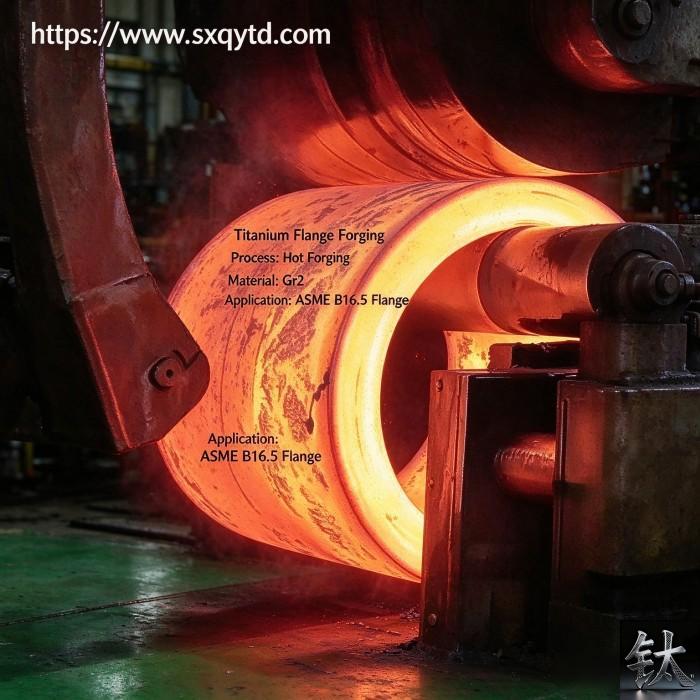
Titanium Flanges are normally produced by forging, which delivers dense metallurgical structure and good mechanical performance for pressure piping. Precision casting is only adopted for special complex‑shaped non‑pressure custom parts.
Three mainstream connection ways:
- Welded connection: Permanent joint, best sealing and structural strength, applied in pressure vessels, offshore piping, chemical reactors and aerospace systems
- Bolted connection: Standard assembly method, easy to disassemble for inspection and maintenance, the dominant form for process pipelines
- Threaded connection: Used for small‑size tubing, instrument lines and low‑pressure non‑corrosive auxiliary loops
Key Advantages of Titanium Flanges
Outstanding Corrosion Resistance
Titanium spontaneously forms a stable passive oxide film on its surface. It resists attack from seawater, brine, wet chlorine, chlorate, nitric acid and many organic media. Service life is greatly extended in chloride‑rich environments such as salt‑lake lithium extraction and desalination plants.
High Strength‑to‑Weight Ratio
Titanium is roughly 40% lighter than steel while maintaining comparable mechanical strength. Weight reduction brings obvious benefits for marine topside, ship piping and airborne equipment.
Non‑magnetic Property
Titanium is non‑magnetic, suitable for magnetic resonance, instrument piping and special electronic industrial environments where magnetic interference must be avoided.
Stable High‑temperature Performance
Gr5 titanium alloy retains good tensile strength and creep resistance under continuous elevated‑temperature working conditions, suitable for high‑temperature process loops.
Excellent Biocompatibility
Pure titanium Gr2 is harmless to human tissue, adopted for medical‑equipment piping and implant‑related fluid systems.
Typical Application Industries
- Chlor‑alkali chemical industry: electrolysis‑cell outlet piping, chlorine and brine delivery
- Salt‑lake lithium extraction: brine concentration, extraction and separation pipelines
- Seawater desalination and marine engineering: offshore platforms, seawater cooling systems
- Petroleum & natural gas: produced water, corrosive wellhead auxiliary piping
- Pharmaceutical and food processing: clean process pipelines requiring non‑contamination
- Power, aerospace and medical‑device manufacturing
Specifications and Inspection
Core specification parameters: Nominal Pipe Size (NPS), Pressure Class (150#, 300#, 600#, 900#, 1500#, 2500#), flange type, sealing face, material grade and governing standard.
Standard inspection scope before shipment: chemical composition analysis, dimensional tolerance check, visual surface inspection, ultrasonic UT non‑destructive testing, hardness and tensile mechanical test, gasket‑surface roughness inspection. All titanium flanges can be supplied with 3.1 material test certificate.
Supply Note
At Shaanxi Qianyi Tuoda Technology Co.,Ltd, we stock a wide range of Gr1, Gr2, Gr5 titanium flanges conforming to ASME B16.5. Custom non‑standard titanium flanges can be forged according to drawings. Small‑batch orders and fast global delivery are supported.
Website: https://www.sxqytd.com
Email: sales@sxqytd.com
Tel: +86‑917‑355‑7966
Location: Baoji High‑tech Zone, China Titanium Valley
- What is Titanium Flange | ASME B16.5 ASTM B381 Gr2 Gr5 Titanium Flan
- ASME B16.5 Titanium Flange Grade2 DN100-DN600 Class150/300 FOB
- Gr2 Titanium Sheet Price FOB Shanghai | ASTM B265 In Stock
- Titanium Price Today (Oct 26, 2026): China Market Report
- Titanium Price Today (23 Oct 2026): Plate, Tube, Rod & Wire
Contact Person: Wang Xiaoning
Tel: +86-917-355-7966
Email: sales@sxqytd.com
WhatsApp: +86 188 2967 9311
Company: Shaanxi Qianyi Tuoda Technology Co., Ltd
Address: Floor 4, Building 4, No. 188 Gaoxin Avenue, High-tech Zone, Baoji City, Shaanxi Province, China